
Curriculum
The Behavioral and Social Data Science Major
Starting August 2026, students in the 2026 - 2028 catalog may opt into one of the two Behavioral and Social Data Science (BSDS) major pathways: Psychology and Humanities.
Students in the 2024 - 2026 catalog will follow the Psychology Concentration course requirements, but will not pursue any of the BSDS Common Courses.
No matter which track you choose, you’ll gain a strong foundation in statistics, programming, and data visualization while also focusing deeply on the kinds of questions that drive your field. The Psychology Concentration looks at human thought, behavior, and emotion. The Humanities Concentration focuses on cultural expression in language, art, and media.
Across both concentrations, students learn to design experiments, analyze data, and communicate results — while reflecting on the ethical, social, and cultural implications of data science in everyday life.
Please review your degree audit profile to determine what "catalog" you belong to.
BSDS 2024-2026 Catalog Degree Plan
Core
General Education - Liberal Arts
Bachelor of Science Coursework
24 - 28 credit hours of coursework chosen from the designated Math and Science lists below.
Major Courses
29 credit hours of coursework from the 2024-2026 BSDS Student list below.
BSDS Psychology Concentration 2026-2028 Catalog Degree Plan
Core
General Education - Liberal Arts
Bachelor of Science Coursework
24 - 28 credit hours of coursework chosen from the designated Math and Science lists below.
BSDS Common Coursework
30 credit hours of coursework. Courses from other degree requirements may be used to satisfy this.
Major Courses
29 credit hours of coursework across the 2026-2028 BSDS Psychology Concentration list below.
BSDS Humanities Concentration 2026-2028 Catalog Degree Plan
Core
General Education - Liberal Arts
BSDS Common Coursework
30 credit hours of coursework. Courses from other degree requirements may be used to satisfy this.
Major Courses
42 credit hours of coursework across the 2026-2028 BSDS Humanties Concentration list below.
- Bachelor of Science Coursework
24 - 28 credit hours of coursework
Required by 2024-2026 BSDS Students and 2026-2028 Psychology Concentration BSDS Students.
NOT required for 2026-2028 Humanities Concentration BSDS Students.- PSY 317L or PSY 120R (completed in major)
- M 408K or M 408C
- Three hours of additional upper-divsion Math*
- TWO of the following FIVE science sequences:
- a. BIO 311C, BIO 311D, and BIO 206L or 208L
- b. CH 301 & CH 104M, and CH 302 & CH 104N
- c. PHY 317K, PHY 105M, and PHY 105N
- or PHY 301, PHY 101L, PHY 316, and PHY 116L
- or PHY 303K, PHY 105M, PHY 303L, and PHY 105N
- or PHY 302K, PHY 105M, PHY 302L, PHY 105N
- d. CS 303E, CS 313E, and one of the following:
- CS 322E, CS 324E, CS 326E, CS 327E, CS 329E**
- e. M 408D or M 408M, M 340L or M 341, and M 346 or M 346K***
Notes:
* Upper-Division Math courses may require additional calculus credits as prerequisites. Please refer to the Math Options document for classes that require three or less calculus courses to enroll.** Students may be required to declare a Programming & Computation Certificate through the College of Natural Sciences to access upper-division CS coursework.
** Students that took Computer Science coursework at another institution should consider taking the UT Austin Exam in Computer Science 303E. Once you earn credit for CS 303E, you can advance to CS 313E. All upper-division Computer Science coursework requires CS 313E as a prerequisite.*** If a student chooses to pursue Math as ONE of the TWO required science sequences, M 340L, M 341, M 346, and M 346K may not be counted towards the 3 hours of additional upper-division Math requirement.
- BSDS Common Courses
ONLY REQUIRED FOR 2026-2028 Psychology and Humanities Concentration Students.
Current 2024-2026 BSDS Students are not required to complete this requirement.
Current 2024-2026 BSDS Students will not automatically be moved into the 2026-2028 catalog.Because BSDS students in the 2026-2028 catalog have the option to pick one of two concentrations, coursework will split within the Major section of the degree. To allow for cross-disciplinary study and ineraction, all students will take a set of Common Courses. Courses from the Major requirements may be used to fulfill these requirements and will be indicated in their respective sections.
- BHD 301 'Introduction to Humanities Data Science'
- One course or three hours of statistics chosen from:
- PSY 317L, SOC 317L, SDS 320E, ECO 329, M 358K, or M 378K
- PSY 317L, SOC 317L, SDS 320E, ECO 329, M 358K, or M 378K
- One course or three hours of programming chosen from:
- PSY 371E, SDS 313, or RHE 314
- PSY 371E, SDS 313, or RHE 314
- One course or three hours of research design and methods chosen from:
- PSY 420M, SOC 320T, SOC 327M, URB 315, or WGS 356
- PSY 420M, SOC 320T, SOC 327M, URB 315, or WGS 356
- Two courses or six hours of data science fundamentals chosen from:
- PSY 371F, LIN 350.12, or ECO 324M
- PSY 371F, LIN 350.12, or ECO 324M
- CS 303E, CS 313E, and one of the following:
- CS 322E, CS 324E, CS 326E, CS 327E, CS 329E*
- CS 322E, CS 324E, CS 326E, CS 327E, CS 329E*
- BHD 350 'Project Management for Humanities Data Science'
Notes:
* 2026-2028 Psychology Concentration students may use the BSDS Common Course CS requirement to satisfy ONE of the Bachelor of Science science sequences listed in the previous section. - BHD 301 'Introduction to Humanities Data Science'
- Accordion 3Panel 3. Add body text in this space.
- Accordion 4Panel 4. Add body text in this space.
- Accordion 5Panel 5. Add body text in this space.
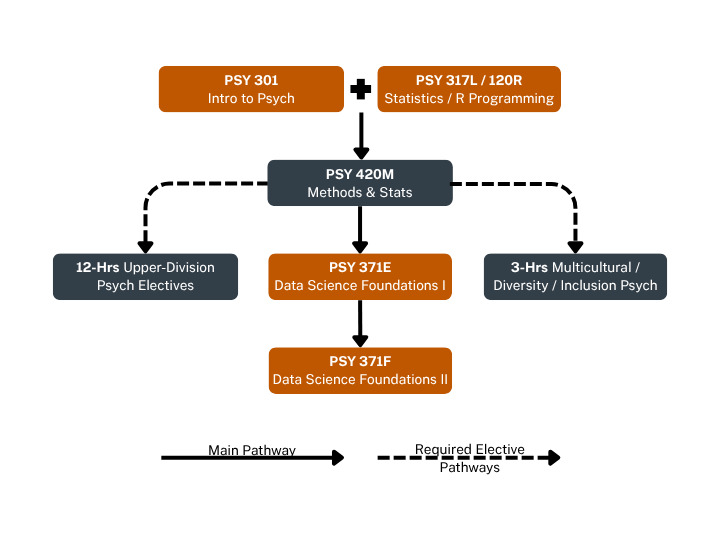
Psychology Concentration
The Behavioral and Social Data Science (BSDS) major combines psychology’s insights into human thought, behavior, and emotion with the tools of data science. Students gain a broad foundation in psychology while also developing skills in statistics, programming, data visualization, and ethical decision-making.
Unlike traditional programs where students had to connect the dots between psychology and data science on their own, BSDS integrates them directly. That means everything you learn — from experimental design to coding in Python or R — is grounded in the real problems and data of human behavior.
Below you can find details regarding the Course Requirements for the 2024-2026 BSDS Degree Plan and the 2026-2028 Psychology Concentration Degree Plan. More complete information is available here.
2024-2026 BSDS Students and
2026-2028 BSDS Psychology Concentration Major Courses
- 16 Credit Hours of Psychology Coursework
-
PSY 301 – Introduction to Psychology
Explore the foundations of human thought, emotion, and behavior, with applications across everyday life. This class gives you the psychological perspective you’ll carry into all your data science training. -
PSY 317L – Statistics for the Behavioral Sciences (or PSY 120R – R Programming, transfer version)
Learn R programming, descriptive and inferential statistics, and data visualization for psychology. You’ll cover t-tests, correlation, regressions, and nonparametric approaches, all with a focus on real-world behavioral data.
*Fulfills the BSDS Common Course statistics requirement -
PSY 420M – Psychological Methods and Statistics
Move beyond the basics into experimental design and intermediate statistical approaches. You’ll learn how to evaluate new findings, design your own studies, and communicate research through writing and presentations.
*Fulfills the BSDS Common Course research design and methods requirement -
PSY 371E – Psychological Data Science Foundations I
Build up your coding skills. This flipped, hands-on course introduces Python, Jupyter Notebooks, and GitHub. You’ll learn to visualize, simulate, and analyze behavioral data while building a personal coding portfolio.
*Fulfills the BSDS Common Course programming requirement -
PSY 371F – Psychological Data Science Foundations II
Take your skills further with regression, generalized linear models, and advanced analysis. You’ll code, visualize, and troubleshoot in class — culminating in a final project and GitHub repository that you can showcase to employers or graduate programs.
*Fulfills 3 credit hours towards the BSDS Common Course data science fundementals requirement
-
- 3 Credit Hours of Multicultural / Diversity / Inclusion Psychology
-
PSY 332U - Diversity in Cognitive Aging
Discuss biological, sociocultural, and environmental factors underlying cognitive aging. Explore how each of these factors dynamically shapes cognitive functioning, brain health, and late-life dementia risk from a life course perspective. -
PSY 333C - Controversial Issues in Development
An exploration of questions in developmental psychology that are currently in dispute. Subjects may include stem cell research, treatment of juveniles in the legal system, physician-assisted suicide, and methods of sex education. -
PSY 339 - Behavior Problems of Children
Adjustment difficulties during childhood and adolescence; causation and treatment.
May also use HDF 342 Development of Psychopathology from Infancy through Adolescence if applicable. -
PSY 364T - Multicultural Psychotherapy
Introduction to multicultural approaches to personality assessment and counseling psychotherapy. -
PSY 365D - Behavioral Science, Equity, and Inclusion
Apply the principles of experimental behavioral science to problems of creating an equitable and inclusive society in the twenty-first century.
-
- 12 Credit Hours of PSY Upper-Division Electives
After the core sequence, students choose four electives (12 hours) to tailor their BSDS training. The following courses are options that reflect BSDS topics, but students may also utilize upper-division PSY coursework not listed here:
-
PSY 341K – Computer Simulations (Cormack)
Model complex psychological systems using computational simulations to understand behavior and psychological phenomena. -
PSY 371M – Introduction to Machine Learning (Yu)
Learn the core algorithms that let computers detect patterns in behavioral data, from prediction to classification. -
PSY 371T – Text Analysis for Behavioral Data Science (Ong)
Analyze language data from sources like social media, large language models, and news to uncover psychological insights. -
PSY 371Q – Ethics in Behavioral Data Science (Ong)
Explore the ethical challenges of data use, including bias, privacy, consent, and fairness in applied contexts. -
PSY 341K – Social Network Analysis (Curley)
Use R to visualize and analyze how social connections influence behavior, beliefs, and group dynamics. -
PSY 341K – Applied Human Signal Analysis (de Barbaro)
Study human behavior through physiological and sensor signals, applying data science to the study of real-world interactions. -
PSY 371P – Applied Data Science (Timmons)
Work on real-world data projects that apply statistical and computational techniques to psychology and health. -
PSY 371S – Bayesian Data Analysis (Etz)
Learn Bayesian approaches to modeling uncertainty, updating beliefs with data, and applying them in psychology. -
PSY 371N – Natural Behavior in the Real World (Yu)
Design studies outside the lab using mobile sensing and video data to analyze everyday human behavior.
-
- Accordion 4Panel 4. Add body text in this space.
- Accordion 5Panel 5. Add body text in this space.
Required Courses
🔹 PSY 301 – Introduction to Psychology
Explore the foundations of human thought, emotion, and behavior, with applications across everyday life. This class gives you the psychological perspective you’ll carry into all your data science training.
🔹 PSY 317L – Statistics for the Behavioral Sciences (or PSY 120R – R Programming, transfer version)
Learn R programming, descriptive and inferential statistics, and data visualization for psychology. You’ll cover t-tests, correlation, regressions, and nonparametric approaches, all with a focus on real-world behavioral data.
🔹 PSY 420M – Psychological Methods and Statistics
Move beyond the basics into experimental design and intermediate statistical approaches. You’ll learn how to evaluate new findings, design your own studies, and communicate research through writing and presentations.
🔹 PSY 371E – Psychological Data Science Foundations I
Build up your coding skills. This flipped, hands-on course introduces Python, Jupyter Notebooks, and GitHub. You’ll learn to visualize, simulate, and analyze behavioral data while building a personal coding portfolio.
🔹 PSY 371F – Psychological Data Science Foundations II
Take your skills further with regression, generalized linear models, and advanced analysis. You’ll code, visualize, and troubleshoot in class — culminating in a final project and GitHub repository that you can showcase to employers or graduate programs.
Upper-Division Electives (12 Hours)
After the core sequence, students choose four electives (12 hours) to tailor their BSDS training. Options include:
-
PSY 341K – Computer Simulations (Cormack)
Model complex psychological systems using computational simulations to understand behavior and psychological phenomena. -
PSY 371M – Introduction to Machine Learning (Yu)
Learn the core algorithms that let computers detect patterns in behavioral data, from prediction to classification. -
PSY 371T – Text Analysis for Behavioral Data Science (Ong)
Analyze language data from sources like social media, large language models, and news to uncover psychological insights. -
PSY 371Q – Ethics in Behavioral Data Science (Ong)
Explore the ethical challenges of data use, including bias, privacy, consent, and fairness in applied contexts. -
PSY 341K – Social Network Analysis (Curley)
Use R to visualize and analyze how social connections influence behavior, beliefs, and group dynamics. -
PSY 341K – Applied Human Signal Analysis (de Barbaro)
Study human behavior through physiological and sensor signals, applying data science to the study of real-world interactions. -
PSY 371P – Applied Data Science (Timmons)
Work on real-world data projects that apply statistical and computational techniques to psychology and health. -
PSY 371S – Bayesian Data Analysis (Etz)
Learn Bayesian approaches to modeling uncertainty, updating beliefs with data, and applying them in psychology. -
PSY 371N – Natural Behavior in the Real World (Yu)
Design studies outside the lab using mobile sensing and video data to analyze everyday human behavior.
Humanities Concentration
The Humanities Concentration of the BSDS major is for students who want to combine data science with the study of culture. Here, you’ll work with texts, images, sounds, and artifacts, asking how digital tools can help us better understand human creativity and communication.
Instead of learning data science in the abstract, you’ll practice it in relation to novels, films, podcasts, visual art, archives, and more. Alongside technical skills in R, Python, and data visualization, you’ll also reflect on how technology and AI shape society — and how culture shapes technology in return.
Below you can find details regarding the Course Requirements for the Humanities Concentration under the 2026-2028 Degree Plan.
2026-2028 BSDS Humanties Concentration
- Core Humanities - 6 Credit Hours
- BHD 319 - Gateway Course for Data Science in the Humanities
Introduction to digital humanities research. Examine how data, algorithms, Machine Learning/Artificial Intelligence, and interpretation shape cultural inquiry in the humanities through hands-on experimentation and critical tinkering using computer programming. Utilize exercises in artifact, text, image, and metadata analysis.
*May also use E 310D Introduction to Digital Studies if applicable.
- BHD 321 – Humanities Research Methods
Prerequisite: BHD 319
Explore approaches to research design in humanities data science with an emphasis on mixed methods, critical and theoretical connections between data science and humanities research programs, ethical frameworks, and the formulation of research questions within specific cultural, disciplinary, and cross-sectoral professional contexts.
- BHD 319 - Gateway Course for Data Science in the Humanities
- 6 Credit Hours of Lower-Division Humanities
- BHD 301 Intro to Humanities Data Science
Introduction to core concepts, methods, and tools in data science from a liberal arts perspective with an emphasis on both technical skill-building and critical reflection. Discuss data ethics, machine learning, archival processing, and the cultural contexts of computational research.
*Fulfills the BSDS Common Course BHD 301 requirement
Additional lower-division options coming soon.
- BHD 301 Intro to Humanities Data Science
- 3 Credit Hours of Upper-Division Humanities
- BHD 340 – Advanced Programming for Humanities Data Science
Prerequisite: BHD 315
Focus on building and refining custom data pipelines and applications in a self-guided research project. Discuss research and data flow planning, critical evaluation, Natural Language Processing (NLP) and computational cultural artifact analysis, including archive processing. Explore modular programming, adapting tools for humanities-specific use cases, and interface design.
- BHD 350 – Project Management for Humanities
Introduction to strategies for managing digital humanities projects from research design and planning to deployment. Discuss team collaboration, corpus and artifact curation, Institutional Review Board (IRB) protocols and legal questions, documentation practices, and navigating the institutional, ethical, and technical dimensions of humanities data science research.
Additional Upper-Division options coming soon.
- BHD 340 – Advanced Programming for Humanities Data Science
- 6 Credit Hours of Methods
- AMS 370 Topic 66 - Art and Data in the Digital Age
Investigate what shapes data and bodies take in digital environments. Ask how computing cultures and networks have been shaped by data and bodies.
- HMN 350 Topic 13 - Treasure Hunt Archival Research
Discover, explore and identify the boundless treasures that can be found on the University of Texas Austin campus as you hunt through the vast cultural and historical collections at the archives on campus including the Harry Ransom Center, the Dolph Briscoe Center for American History, and the LLILAS Benson Latin American Collection. Explore essential skills for pursuing original research projects in humanities disciplines and apply these skills to bring public attention to hidden histories and marginalized voices in American culture.
- GSD 351D - Identity, Codes, and Culture
Explore how to read identities as patterns in literary texts, linguistic and cultural corpora with digital methods, and come to a deeper understanding of individual texts and textual phenomena. Examine digital research methods, tools, and use cases. Work hands-on with literary and linguistic sources.
- AMS 370 Topic 66 - Art and Data in the Digital Age
- 9 Credit Hours of Applied Digital Studies I
- GRG 324E - Applications and Ethics of Digital Spatial Technologies
Explore the applications and ethical considerations of remote sensing, the Global Positioning System (GPS), and Geographic Information System (GIS) technologies and practice.
- RHE 312 - Writing in Digital Environments
A writing course focused on using, interpreting, and analyzing traditional and emerging technologies.
Additional Applied Digital Studies I options coming soon.
- GRG 324E - Applications and Ethics of Digital Spatial Technologies
- 9 Credit Hours of Applied Digital Studies II
-
C C 370 - Quantitative Criticism
Introduction to collaborative research and cross-disciplinary methods in the study of language and culture. Explore the literature of Ancient Greece and Rome which provides a convenient model for longue duree cultural analysis, but examples discussed come from diverse fields. -
RHE 330C.14 - Rhetorical Metrics
Explore an introduction to text analytics with a focus on computational and statistical methods within rhetorical studies. -
AFR 353C / HIS 324C - Mapping Urban Destruction
Investigates how demolitions have shaped the material and social lives of two compelling, rapidly-changing global cities: Sao Paulo and Austin. Develop technical skills in digital mapping in a supportive environment.
Additional Applied Digital Studies II options coming soon.
-
- 3 Credit Hours of Capstone
- GOV 362L - Government Research Internship
Fieldwork in research and analysis on governmental and political problems.
-
L A 320D - Digital Humanities Internship
- GOV 362L - Government Research Internship
- Accordion 3Panel 3. Add body text in this space.
- Accordion 4Panel 4. Add body text in this space.
- Accordion 5Panel 5. Add body text in this space.
Required Courses
🔹 BHD 301 - Introduction to Humanities Data Science
Introduction to core concepts, methods, and tools in data science from a liberal arts perspective with an emphasis on both technical skill-building and critical reflection. Discuss data ethics, machine learning, archival processing, and the cultural contexts of computational research
🔹 BHD 315 - Programming for Humanities Data Science
Introduction to computer programming for the humanities and to digital humanities as a research area. Examine basic programming concepts, data types, functions, and Application Programming Interfaces (API). Learn the first steps in building data pipelines and explore introductory natural language processing (NLP) techniques through humanities-centered applications.
🔹 BHD 319 – Gateway Course for Data Science in the Humanities
Introduction to digital humanities research. Examine how data, algorithms, Machine Learning/Artificial Intelligence, and interpretation shape cultural inquiry in the humanities through hands-on experimentation and critical tinkering using computer programming. Utilize exercises in artifact, text, image, and metadata analysis.
🔹 BHD 321 – Humanities Research Methods
Prerequisite: BHD 319
Explore approaches to research design in humanities data science with an emphasis on mixed methods, critical and theoretical connections between data science and humanities research programs, ethical frameworks, and the formulation of research questions within specific cultural, disciplinary, and cross-sectoral professional contexts.
🔹 BHD 340 – Advanced Programming for Humanities Data Science
Prerequisite: BHD 315
Focus on building and refining custom data pipelines and applications in a self-guided research project. Discuss research and data flow planning, critical evaluation, Natural Language Processing (NLP) and computational cultural artifact analysis, including archive processing. Explore modular programming, adapting tools for humanities-specific use cases, and interface design.
🔹 BHD 350 – Project Management for Humanities
Introduction to strategies for managing digital humanities projects from research design and planning to deployment. Discuss team collaboration, corpus and artifact curation, Institutional Review Board (IRB) protocols and legal questions, documentation practices, and navigating the institutional, ethical, and technical dimensions of humanities data science research.
Upper-Division Electives (12 Hours)
- TBD