
Digital Technologies Cognition among Older Adults
Does Use of Digital Technologies Help or Harm Cognition among Older Adults?
Jared F. Benge and Michael K. Scullin
This brief is based on a recent meta-analysis [1], or research study that combines and analyzes results from many individual studies. In this case, the meta-analysis examined how everyday use of digital technology is related to cognitive health and memory in adults aged 50 and older. People in this age group were the first generation to adopt computers, smartphones, and the internet as adults, and now they have reached the age where risks of dementia emerge.
The authors of the meta-analysis sought to know if digital technology helps or harms cognitive health as people age. They tested two hypotheses. The digital dementia hypothesis predicts using technology throughout one’s life worsens cognitive abilities. An alternative hypothesis is that using technologies in everyday life leads to “technological reserve,” wherein digital technologies promote behaviors that preserve cognition.
The authors assessed the full text of 592 journal articles on the subject to determine if they were eligible to include in the meta-analysis; 136 high-quality studies met the inclusion criteria. Of the 136 papers included in the meta-analysis, 57 papers with 411,430 research participants were compatible with the meta-analysis’ statistical analyses. These one-point-in-time (cross-sectional) and long-term (longitudinal) individual studies measured the use of computers, the internet, and smartphones. They also accounted for factors such as age, income, health, education, and other characteristics and behaviors associated with brain health.
For the outcome of cognition, studies included in the meta-analysis focused on risk of cognitive impairment and cognitive decline over time. These outcomes were based on cognitive test scores and diagnoses of dementia and mild cognitive impairment.
Findings
The use of digital technology among older adults was linked to better cognitive outcomes. Across 57 high-quality studies from around the world, use of computers, smartphones, and the internet was linked to a lower likelihood of cognitive impairment. Older adults who used digital technology were also less likely than older adults who did not use digital technology to experience cognitive decline over time.
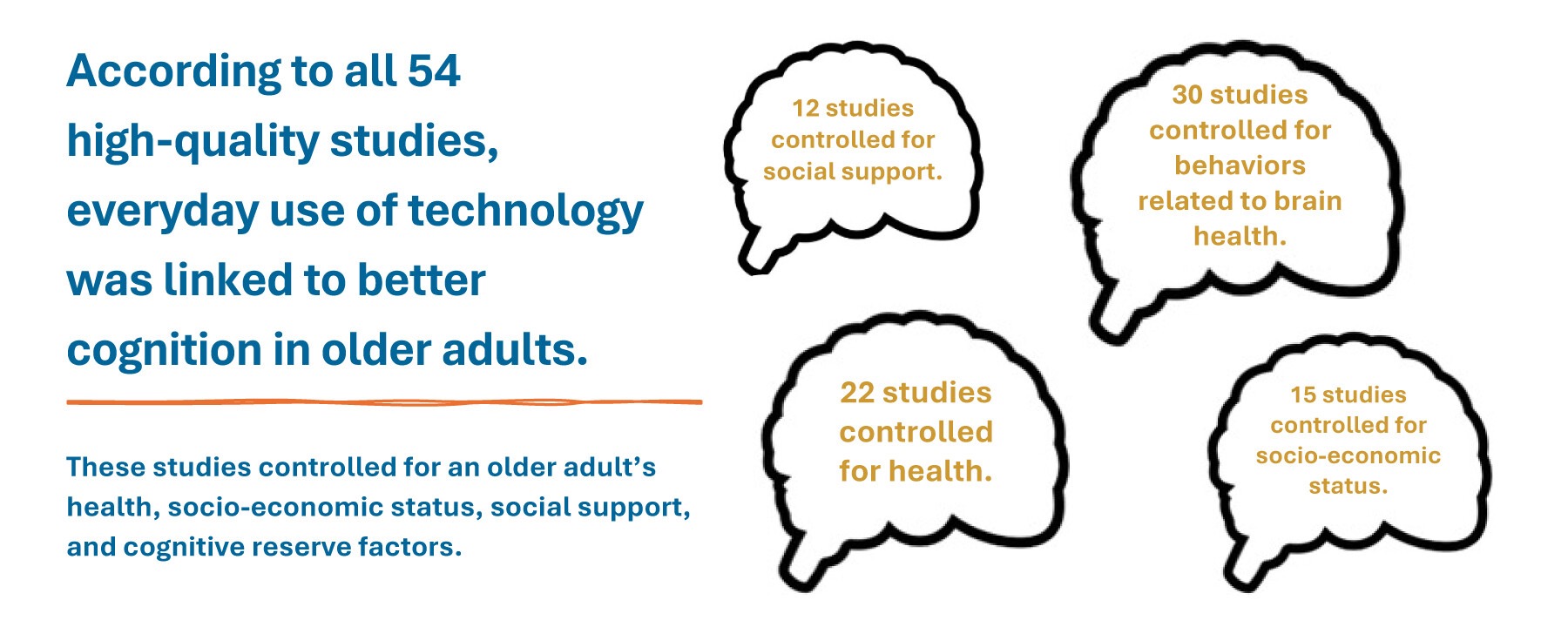
The benefits of using digital technology to cognitive health remained after controlling for factors often associated with brain health. These factors included education, socioeconomic status, health, and cognitive reserve. The term, cognitive reserve, refers to characteristics and behaviors associated with brain health such as the complexity of one’s job, the frequency and quality of social interactions, participation in mentally stimulating activities, life-long learning, etc. (See figure).
The meta-analysis found no evidence of “digital dementia.” None of the studies reviewed showed that using digital technology increased the risk for dementia. Rather, the findings of the meta-analysis raise the possibility that technologies that promote complex mental activities, connection to family, friends, and the larger world, and behaviors to help people remember tasks and events such as using calendars, reminders, and note-taking, may benefit cognitive health as people age.
Key Findings
- The use of digital technology among older adults was linked to better cognitive outcomes.
- The benefits to cognitive health remained after controlling for factors often associated with brain health.
- There was no evidence of “digital dementia.” None of the 57 studies reviewed showed that using digital technology increased the risk for dementia.
Policy implications
Findings from the meta-analysis challenge the narrative that using digital technology is universally harmful to cognition. Instead, use of technology likely supports cognitive health as people age and provides public health benefits. Policies and programs should promote equitable access to digital tools and training for older adults to use them effectively. They should encourage technologies that stimulate peoples’ brains, connect people to family, friends, and the wider world, and help people remember events and navigate daily tasks. Integrating the use of technology into initiatives on healthy aging may foster cognitive resilience and independence among older adults. Policies and programs should ensure safe, inclusive, and user-friendly digital tools to maximize benefits while minimizing risks such as scams and compulsive use of social media, games, etc.
Data and Methods
The authors conducted a systematic review and meta-analysis that followed PRISMA 2020 guidelines. The authors independently reviewed studies in stages from titles to abstracts to full-text journal articles. Using seven large research databases, they began by screening more than 29,000 records. After culling these down for eligibility, the authors assessed the full-text of 592 articles published between 2011 and 2024 for eligibility and ended up with 136 papers that met their eight criteria for inclusion. To be included, studies must have been observational or cohort studies focused on the use of digital technology among adults aged 50 or older and included outcomes based on cognitive tests or a diagnosis for mild cognitive impairment or dementia. Of the high-quality 136 papers included, 57 were compatible with the meta-analysis’ examination of odds ratios or hazard ratios. The sample of 57 papers included 411,430 adults aged 50 and older with an average age of 69 years at baseline assessment. Approximately half (54%) of participants were female. For studies with a longitudinal design, average duration of follow up was 6.2 years. About a quarter (26%) of studies resulted in a diagnosis determining dementia or mild cognitive impairment, and 74% of studies resulted in cognitive testing.
For the 57 studies, the authors converted study findings into odds ratios or hazard ratios and combined them to estimate overall effects. They also tested the role of other factors on effect sizes using meta-regressions. (An effect size measures the strength, or magnitude, of a relationship between variables or the practical significance of a study's result.) The authors tested the impact of sample characteristics (average age at baseline, percentage female, sample size and income level of the country where study was conducted). They tested the impact of study characteristics (whether the study was cross-sectional or longitudinal, the year data collection began, National Heart, Lung, and Blood Institute’s study quality ratings, whether the outcome was cognitive test or diagnosis, and whether data collection required the use of digital technology or not). The authors also tested the impact of conceptual factors (whether each study’s effect size adjusted for socioeconomic status, health, social support, and characteristics associated with the brain’s ability to adapt or use alternative strategies to maintain cognitive function despite aging.
Reference
[1] Benge, J. F., & Scullin, M. K. (2025). A meta-analysis of technology use and cognitive aging. Nature Human Behaviour 9, 1405–1419. https://doi.org/10.1038/s41562-025-02159-9
Suggested Citation
Benge, J. F., & Scullin, M. K. (2026). Does use of digital technologies help or harm cognition among older adults? CAPS Research Brief 5(01). https://doi.org/10.26153/tsw/62294
About the Authors
Jared F. Benge, jared.benge@austin.utexas.edu, is associate professor in the Department of Neurology and a faculty affiliate in the Center for Aging and Population Sciences; Michael K. Scullin is professor of psychology and neuroscience at Baylor University.
Acknowledgements
This research was supported by the National Institutes of Health (R01AG082783), the National Science Foundation (1920730 and 1943323), and the Alzheimer’s Association (AARG-22-924771). The content is solely the responsibility of the authors and does not necessarily represent the official views of the funding agencies.