
Liberal State Policies Improve Life Expectancy
Link to Original Article (Open Access)
Jennifer Karas Montez, Jason Beckfield, Julene Kemp Cooney, Jacob M. Grumbach, Mark D. Hayward, Huseyin Zeyd Koytak, Steven H. Woolf, and Anna Zajacova
Introduction
The life expectancy of people in the United States compares poorly to populations in high-income countries: the U.S. ranked 13th in life expectancy in 1980 among 22 such countries and fell to last place by the early 2000s. Life expectancy is a composite measure that captures overall social, economic, physical and mental well-being in a population. The U.S.’s low ranking relative to other rich countries paints a troubling portrait of Americans’ prospects of life and death.
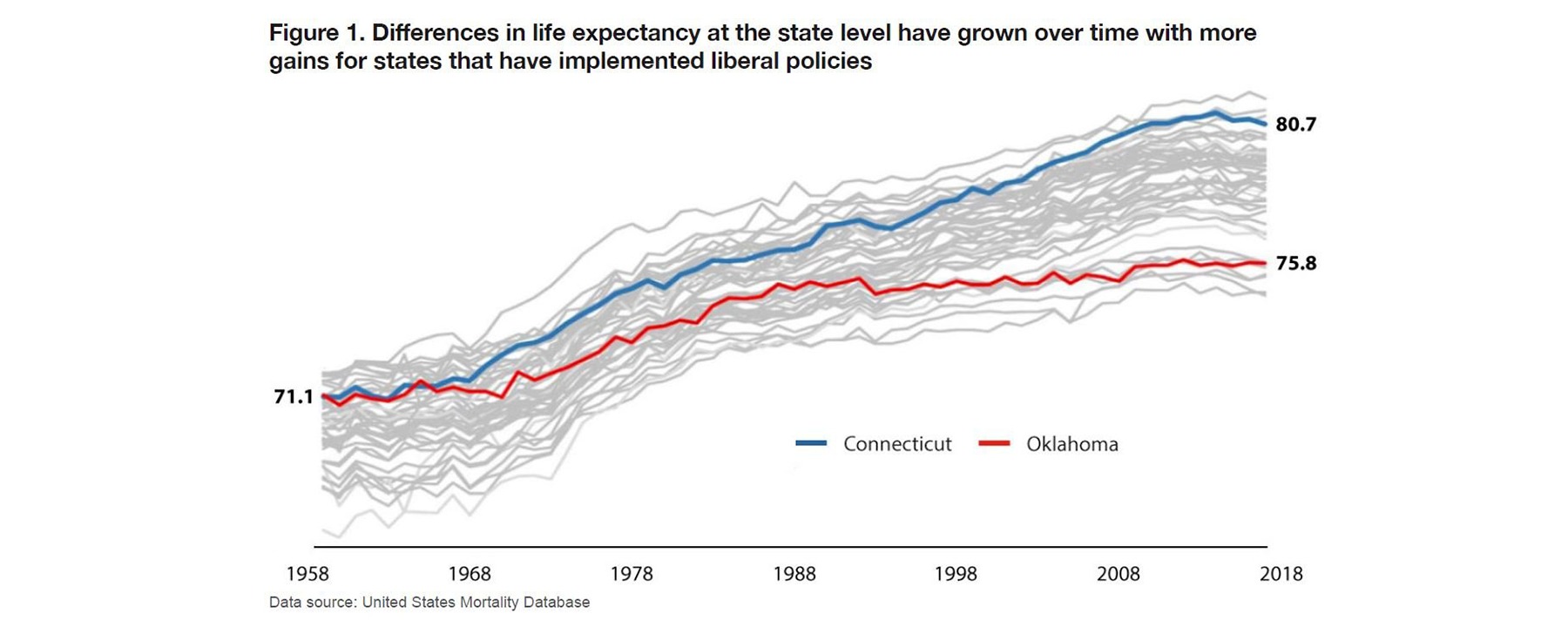
More troubling still is that these national averages obscure large differences across the states, which in 2017 ranged from a high of 81.6 years Hawaii to a low of 74.6 years in West Virginia. Moreover, the life expectancy of residents in different states has diverged in recent decades. For example, as shown in Figure 1 [1], residents of Connecticut and Oklahoma had the same life expectancy in 1959 (71.1 years) but by 2017, people who lived in Connecticut – a state which has implemented more liberal policies – enjoyed a life expectancy of 80.7 while those in Oklahoma – which has implemented more conservative policies – had a life expectancy of 75.8, a difference of 4.9 years.
Edit Headline Text
Edit Subhead Text
Photo Credit.
Because of these state differences in life expectancy, many researchers argue that it is important to evaluate the impact of state policies that affect health outcomes, and therefore the life expectancy of states’ residents. State policies influence economic well-being, environmental impacts on health, medical care access, and individual behaviors. Policies also shape opportunities for state residents to attain education, housing, and other factors that impact the ability to live a healthy life.
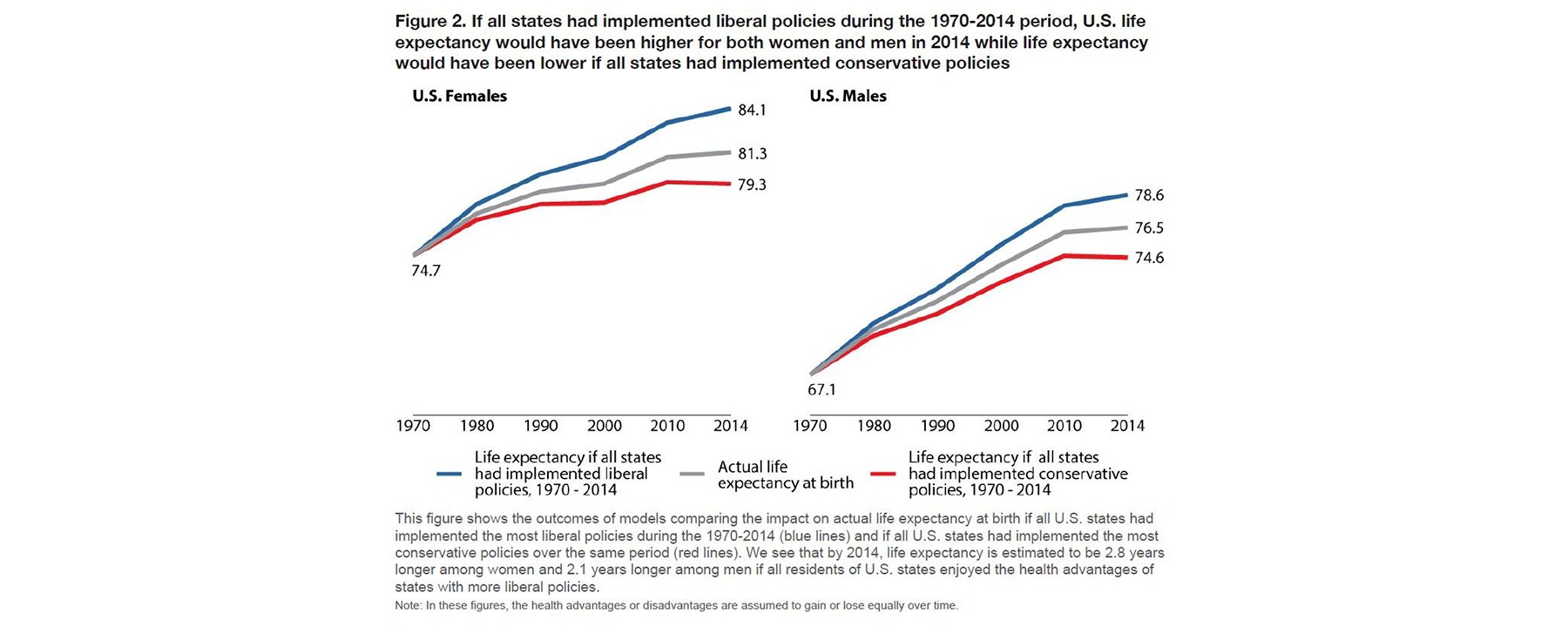
In this study, the authors used annual data on life expectancy in U.S. states from 1970 to 2014 and merged it with annual data on 18 state-level policy domains, for example those concerning labor, tax, environment, abortion, gun control, and tobacco. They then modeled the association between state policies and female and male life expectancy, controlling for differences in the characteristics of states and their populations. They also explored a hypothetical question: if all states were to implement the most liberal – or the most conservative – policies over the period 1970-2014, what impact would this have had on national estimates of life expectancy for women and men?
Key Findings
- States that implemented more liberal policies during the 1970-2014 period that expanded economic regulations and protected marginalized groups saw a rise in their life expectancy while states that implemented more conservative policies were more likely to see a lowering of life expectancy for its residents.
- If all states had implemented the most liberal policies during the 1970-2014 period, U.S. women would have lived 2.8 years longer and men 2.1 years longer by 2014. See Figure 2.
- On the other hand, if all states had implemented the most conservative policies during the 1970-2014 period, U.S. women would have lost 2.0 years of life expectancy and men would have lost 1.9 years by 2014. See Figure 2.
- Liberal policies on tobacco, labor, immigration, civil rights, and the environment predicted a nearly 1-year increase in that state’s life expectancy.
- Other policies also mattered. For example, more liberal policies on abortion and gun control predicted longer life expectancy among women, while more conservative marijuana policies predicted longer lives for both women and men
Edit Headline Text
Edit Subhead Text
Photo Credit.