
Australian and New Zealand Studies in the World
Australian and New Zealand studies is taught and researched at universities on five continents. Harvard has had a Visiting Professorship in Australian Studies since 1976, established by a gift from the Australian government and administered by its Committee on Australian Studies. The Menzies Center for Australian Studies, now at King’s College London, has been endowed by the Australian government since 1982. Georgetown University’s Center for Australian, New Zealand and Pacific Studies was established in 1995 with funding from the governments of both countries. The Edward A. Clark Center for Australian and New Zealand Studies was established at UT Austin thanks to private support in 1988, which makes it the longest existing university center for Australian and New Zealand studies in the United States. Bob Hawke, then Prime Minister of Australia, came to Austin to inaugurate it. In 2001, when Aotearoa New Zealand was added to the Center’s remit, James Bolger, a former Prime Minister then serving as New Zealand’s Ambassador to the United States, came to mark the occasion.
In North America, the field meets through the Australian and New Zealand Studies Association of North America. Founded in 1989, ANZSANA is the scholarly association for the study of Australia and New Zealand on this continent, and it brings together historians, political scientists, lawyers, literary scholars and economists along with the diplomats and journalists whose work touches the two countries. It has met since the early 1990s at Georgetown, Harvard and UT Austin, at McGill and the University of British Columbia, and twice in Mexico with the University of Guadalajara, in 2018 and at Puerto Vallarta in 2020. It is now rebuilding as a year-round online community, with programming planned on Indo-Pacific competition, critical minerals, climate change and artificial intelligence.

The Hon. Peter McGauran, Australia’s Consul-General in Houston, addressing the 2019 ANZSANA conference in Austin.
The Clark Center has been part of ANZSANA since it began. John Higley, the Center’s founding director, co-founded the Association and served as its president from 1997 to 1999. The Center’s current director, Dr. Rhonda Evans, has held office in the association continuously since 2005—as vice-president to 2007, president from 2007 to 2011, board member to 2013, and secretary-treasurer since. UT Austin has hosted ANZSANA’s annual meeting four times, in 1999, 2008, 2014 and 2019. The Center has also been a steady source of financial support for the association, underwriting the costs of the meetings it has hosted and helping to keep its programming going between conferences. The John Higley Prize, established in 2019 and named for the Center’s founding director, goes to the best graduate student paper presented at a meeting. The Center awards travel grants to UT Austin faculty and students presenting at ANZSANA, and the association offers graduate students small travel grants and waived registration.
The American Association of Australasian Literary Studies covers the literary side of the same ground in North America, and it began partly at UT Austin. Robert L. Ross, a scholar here, was among its founders in 1986, and he founded and edited its journal, Antipodes. From about 1991 the journal was published in cooperation with the Clark Center, where Ross was a Research Associate. Ross edited the journal for a dozen years at the Center. Antipodes is still going, twice a year in June and December, now published by Wayne State University Press with support from Vassar College. Peter Pierce’s Cambridge History of Australian Literature calls it “the most significant overseas journal of Australian literature,” and it is indexed in the MLA International Bibliography and AustLit.
Beyond North America, universities in Europe, Asia and South America run their own centers, endowed chairs and journals. The European Association for Studies of Australia draws about 150 members working at 113 institutions across 27 countries. There are centers at Cologne, which coordinates Australian studies across several German universities; at the University of Barcelona, which publishes the peer-reviewed open-access journal Coolabah; at University College Dublin, home to the Keith Cameron Chair of Australian History; and at Debrecen in Hungary. India has dedicated centers at Bankura, Burdwan and Kerala, at Swami Vivekananda University, and a Center for India Australia Studies at O. P. Jindal Global University, and Bankura held its fourth international conference in February 2026. Japan sustains a national association and centers at the University of Tokyo and Nanzan University. There is a center in Uruguay, at la Universidad ORT. Within Australia, the Australian National University and the University of Melbourne are the field’s largest institutional homes, alongside the Whitlam Institute at Western Sydney University and the Bob Hawke Prime Ministerial Center in Adelaide.
By far, the largest concentration of Australian Studies centers is in China, where over 40 universities house one, with three more in Taiwan. The Chinese Association for Australian Studies, founded in 1988 and based at Beijing Foreign Studies University, coordinates them and publishes the Chinese Journal of Australian Studies. Peking University’s center, established in 1996, hosts the annual conference of the Foundation for Australian Studies in China, and the center at Renmin University of China, established in 1999, is the largest of them. The international conference on Australian studies in China reached its 21st meeting in October 2025 at East China Normal University, drawing more than 200 scholars and marking the 40th anniversary of that university’s own Australian Studies Center.
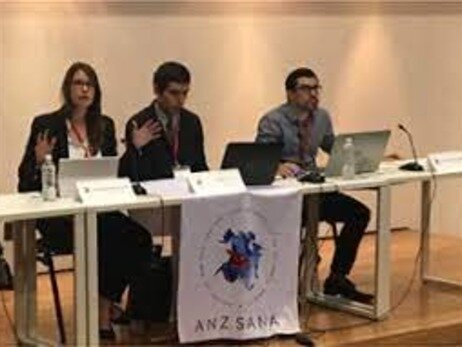
UT Austin graduate student Carolina Moehlecke presenting at the 2018 ANZSANA meeting in Guadalajara.
The Clark Center works through this global network. It is one of the Australian National University’s Australian Studies Institute four partner centers worldwide for its international fellowships, alongside the Center for Australian Studies at the University of Cologne, the Menzies Australia Institute at King’s College London, and Georgetown. Dr. Evans held a visiting fellowship at the Institute in 2022, and ANU sent Dr. Anton Moiseienko of its College of Law to Austin the following year as the first of a funded series.
Since 2012, the Center has hosted more than 90 visitors and organized 31 events, and its Small Grants Program has funded 25 research projects by UT Austin faculty and graduate students and by visiting scholars. Holders of the Harvard Chair in Australian Studies have come to Austin: Tim Flannery in 1999, Peter Beilharz in 2000, Tim Rowse in 2003, Stuart Macintyre in 2008 and Warwick Anderson in 2019. Other visiting scholars have come from ANU, Central Queensland University, the University of Guadalajara and the University of Melbourne, several of them to work in the C. Hartley Grattan collection at the Harry Ransom Center.
In 2018, Dr. Evans gave three lectures at the Australian Studies Center at Renmin University of China, the first American scholar invited to speak there. COVID prevented the Australian Studies Center’s Director, Professor Zhang Yongxian, from visiting UT Austin to attend the ANZSANA meeting in 2019. Clark Scholars have presented their research alongside honors students at ANU in 2015 and at the University of Auckland in 2016. In 2021, the Center’s Great Barrier Reef study abroad course ran in tandem with a class from Georgetown taught by Alan Tidwell, the Director of its Center for Australian, New Zealand and Pacific Studies. Subsequent changes to the UT Austin academic calendar prevented that partnership from continuing. Dr. Evans has served on the editorial boards of the Journal of Australian Studies and the Journal of Australian, Canadian, and Aotearoa New Zealand Studies.