
Italian
Why study Italian?
-
Italian can boost career prospects in international business, fashion, design, publishing, translation, teaching, cuisine, and non-for-profits.
-
Italian is a diaspora language with over 80 million people worldwide claiming Italian heritage.
-
Italy has the most UNESCO world heritage sites and is the birthplace of humanism and the Renaissance.
-
Italian makes an excellent double major with popular UT majors like Business, Government, and International Relations.
-
Italian is not only a phonetic language but also melodic and musical making it easy to learn and fun to speak.
-
UT Austin has numerous faculty-led and affiliate programs in Italy.
If you are interested in majoring in Italian, see more information on the Italian Studies Undergraduate Major.
Interested in Certification of Italian As a Foreign Language (CILS)? Check out the info page here.
🇮🇹🌍 Check out this video and explore course offerings here.
Add Video Headline Here
Add video description here.
Other Online Learning Resources
Giornate Italiane
In this open educational resource (OER), you will find a variety of at-home and in-class activities to help you gain a comprehensive understanding of Italian language and culture.
Giornate Italiane is divided into two parts: Units 1-6 cover beginners skills in Italian, while Units 7-11 cover intermediate skills. Our approach to this resource put communicative skills at the forefront of the language learning experience, allowing students the ability to play with language while learning the valuable skills that comprise our understanding and ability to participate in realistic scenarios.
This resource was designed following the flipped classroom model and is structured in a manner that allows students to learn concepts and lexicon, then check their comprehension with integrated H5P activities with instant feedback. During synchronous class time, students will work together to solidify the concepts studied through communicative task basked activities. These materials & activities are clearly defined in the units with the subheadings “A CASA” and “IN CLASSE”.
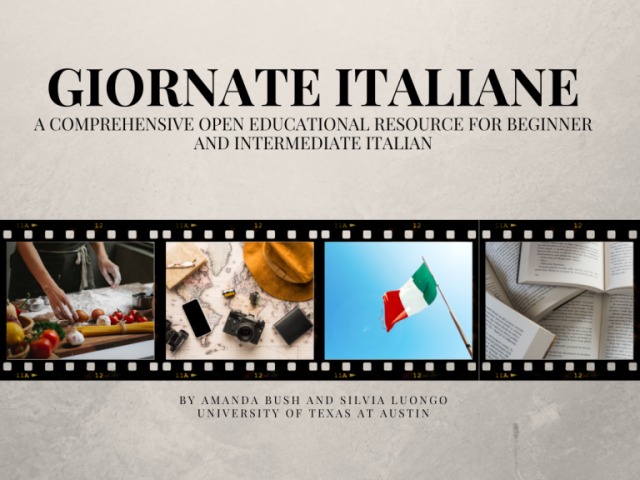
Photo Credit.
Radio Arlecchino
16th-century Commedia dell'arte meets 21st-century podcasting!
Students of Italian and the chronically curious are invited to subscribe and listen: Radio Arlecchino is on the air! The stickier points of Italian grammar are elucidated by Italian faculty members Antonella Olson and Eric Edwards with the assistance--interference?--of Arlecchino, Pulcinella, Colombina and other characters from the Commedia dell'arte.
The podcast offers our students grammar without the grind and cultural and vocabulary notes on the go. Listeners can ask questions and leave comments on the Blog. Buon lavoro e buon divertimento!

Danteworlds
Danteworlds, is an integrated multimedia journey--combining artistic images, textual commentary, and audio recordings--through the three realms of the afterlife (Inferno, Purgatory, Paradise) presented in Dante's Divine Comedy.
The subject of an interview on the home page of the University of Texas at Austin, Danteworlds was selected for inclusion on EDSITEment in 2008 as "one of the best online resources for education in the humanities," and was featured in the literary blogs of the New Yorker (Jan. 8, 2009) and the Los Angeles Times (Jan. 14, 2009).
The Danteworlds Web site contains an abridged version of the original commentary contained in The Complete Danteworlds: A Reader's Guide to the Divine Comedy (2009) and Danteworlds: A Reader's Guide to the Inferno (2007), both published by the University of Chicago Press. The Complete Danteworlds also features historical overviews of the three realms, plot summaries for each region (circles of Hell, terraces of Purgatory, spheres of Paradise), a chronology of major events in Dante's life, illustrations of the three realms, a map of Italy in the 13th Century, additional study questions, and an extensive bibliography (classical and medieval sources as well as modern studies and translations).

Photo Credit.