
Public Humanities Professionalization
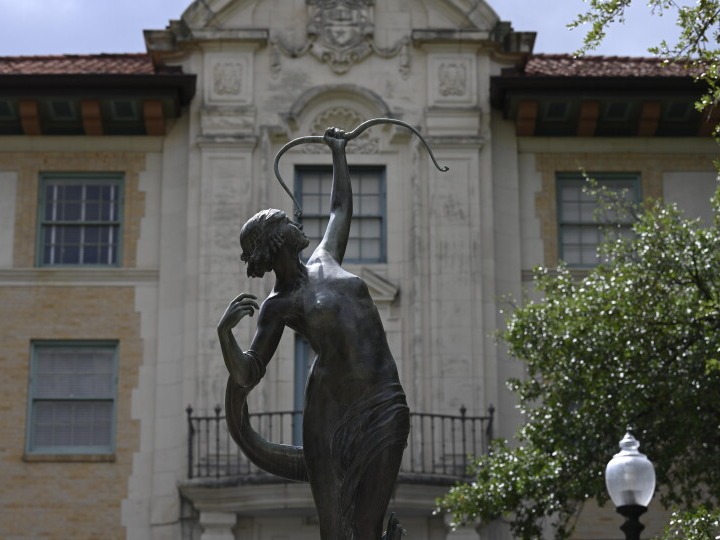
This caption describes the image above.
Public Humanities Professionalization
The Public Humanities Professionalization program is a collaborative program with Humanities Institute, Digital Writing and Research Lab, LLILAS Benson Digital Scholarship Office, Scholars Lab, and University Writing Center. Participants take a series of professional development workshops to earn a Public Humanities Professionalization badge.
To stay up to date with HI programs and events, join our newsletter.
- Eligibility: Graduate Students
- Award: Each participant will receive the Public Humanities Professionalization badge upon completion of the program.
- Timeframe: current academic year
- Deadline to complete: May 15 of current academic year
Questions about the Public Humanities Professionalization Program can be directed to Tanya Clement. Fill out the following Interest Form to receive emails about upcoming workshops.
Badge requirements:
- Attend at least six hours of four different workshops listed below across at least two of the following units: Humanities Institute, Digital Writing and Research Lab, LLILAS Benson Digital Scholarship Office, Scholars Lab, and University Writing Center. To determine currently scheduled workshops, please click the link of each of the units below.
- Submit a project, portfolio, or report that demonstrates achievement of three to five of the following learning outcomes:
- Evaluate an organization: Analyze an organization relevant to a public humanities project, addressing its mission, goals, audiences, resources, and community context. Identify at least one opportunity and one challenge related to potential public engagement.
- Analyze stakeholders: Identify key stakeholders and audiences, describe their interests, needs, perspectives, and roles, and explain how stakeholder considerations inform project goals or engagement strategies.
- Communicate for diverse audiences: Create at least one public- facing communication that translates humanities research or knowledge for a defined audience outside the traditional academic context. The communication must demonstrate clarity, accessibility, audience awareness, and appropriate use of humanities expertise.
- Develop a sustainable project plan: Create a project plan or grant proposal narrative that establishes measurable goals, identifies stakeholders and organizational partners, outlines activities and deliverables, provides a realistic timeline, and identifies resources and strategies needed to sustain the project.
- Evaluate and refine a project: Assess the proposed or completed project using evidence and stakeholder perspectives. Identify specific strengths, limitations, and actionable revisions that would improve the project's effectiveness, public relevance, or sustainability.
Submit the above to Tanya Clement with the following information:
1. Contact information
- Name
- EID
- Email address
2. A list of attended workshops and include:
- Collaborating institution
- Workshop title
- Date
Workshops
Humanities Institute
-
Fellowship Proposal Review Workshop, 60 minutes
- Description: In this workshop, attendees will come together to provide feedback to each other on working drafts of proposals. Sessions will be offered for graduate students.
-
Grad Student Fellowship Application Materials Workshop, 90 minutes
-
-
Grad Student Fellowship Proposal Development Workshop, 60 minutes
- Description: This workshop is designed to provide graduate students with the opportunity to prepare for fellowship proposal applications. Topics covered will include: 1) strategies to help you write for the “genre” of fellowship proposals, 2) selected external funding opportunities, and 3) budget considerations for proposals.
Digital Writing and Research Lab
-
Establishing a Digital Research Ecology, 90 minutes
- Description: Research increasingly involves managing a continuous stream of articles, alerts, newsletters, notes, citations, and digital materials and in many registers from academic to public sources. This workshop will help you design a sustainable digital research ecology that moves information from discovery to collection, organization, and eventual use. We’ll explore tools and techniques for automating parts of this process while keeping researchers in control of what they collect and why. We will pay special attention to combining both academic and public oriented discourse.
- Activity: Map your existing research workflow and build a customized system for discovering, capturing, organizing, and revisiting research materials.
-
Writing Processes and Platforms, 90 minutes
- Description: Writing rarely happens in a single document anymore. Notes, PDFs, bookmarks, citations, drafts, AI tools, and collaborative platforms all shape how a project develops. This workshop will help you design a writing process across platforms, with particular attention to how information moves from collection and annotation into drafting, revision, and publication.
- Activity: Create a platform map of your current writing process, identify points of friction or redundancy, and redesign one project workflow from research through composition.
-
Planning a Podcast Series, 90 minutes
- Description: A successful podcast is more than a good conversation and a microphone… it requires a concept that can sustain multiple episodes, a clear audience, and a repeatable format. This workshop will help you develop an academic and researched idea into a public-facing, coherent podcast series, from the larger concept and episode arc to guests, formats, and production planning.
- Activity: Develop a podcast series blueprint, including its central concept, intended audience, recurring format, and a preliminary plan for three episodes.
LLILAS Benson Digital Scholarship Office
-
Describing and Interpreting Museum Artifacts, 90 minutes
- Description: Academics need to describe and interpret, succinctly and accessibly, the complex histories embodied by artifacts in museum exhibitions. Through a selection of hands-on workshops, you will learn how to handle, assess, describe, analyze, and write about artifacts for museum exhibitions using historical materials drawn from the Benson Latin American Collection as case studies. Application and permission from the instructor is needed since the workshops are given as part of a graduate-level “Historical Museums” class.
- Activity: Develop condition assessments or interpretive exhibition labels
-
Visualizing Cultural Heritage, 90 minutes
- Description: The visualization of archival and bibliographic meta/data gives the public the ability to explore cultural heritage in ways that would not be possible in the physical world. Visualization tools enable you to illustrate connections between cultural heritage, people, geography, and across time, facilitating not only information retrieval but also learning, teaching, and research. Through a selection of hands-on workshops, you will learn how to transform descriptive information (e.g., archival metadata and bibliographic catalog records) into datasets that can be used to visualize their connective, geospatial, and temporal dimensions. Permission from the instructor is needed since the workshops are given as part of a graduate-level “Digital Libraries” class.
- Activity: Develop digital maps, network visualizations, or interactive timelines using cultural heritage descriptive records.
Scholars Lab
-
Creative Coding: Computational Approaches to Sound and Music, 60 minutes
- Description: In this virtual workshop, you will learn how computational methods can be used to create music and sound art, and explore ways to incorporate these approaches into your own creative practice.
-
AI & Research: Inputs, Outputs, and Ownership, Online, 60 minutes
- Description: Generative AI raises copyright questions at every stage of the creative and research process. This online workshop will help you explore practical and ethical approaches to using AI in teaching, research, publishing, and creative work.
- Activity: Complete a brief evaluation of the strengths, limitations, and ethical considerations of AI-assisted output.
University Writing Center
-
Pitching Your Project to the Public, 90 minutes
- Description: Academic projects often need to travel beyond academic genres to potential collaborators, funders, community organizations, journalists, and broader publics. This workshop will help you identify what matters about your research to different audiences and develop concise, compelling ways to communicate its stakes without simply “dumbing it down.”
- Activity: Develop and workshop a short public-facing pitch for a current research project, tailored to a specific audience and purpose.
-
Writing with Community Partners, 90 minutes
- Description: Community-engaged research requires different writing practices than research conducted primarily for academic audiences. This workshop will help you develop approaches to writing with rather than simply about community partners, with attention to collaboration, reciprocity, audience, and the circulation of research beyond the university.
- Activity: Map the people, relationships, and forms of writing involved in a current or prospective community-engaged project, then develop a plan for how writing can support collaboration across the project.
Producing Literary Exhibitions, March 9th, 2026 and August 17, 2026
This two-session workshop reflected on the production of the summer 2026 Harry Ransom Center exhibition “The Worlds of Gertrude Stein,” curated by Dr Sophie Oliver (University of Liverpool). Emerging from Stein’s ‘personal effects’ collection at the HRC, the exhibition aimed to ask questions about the value of such objects – clothing, stationery and other domestic items – in representing literary lives and work. Contributing both to the development of ‘The Worlds of Gertrude Stein’ and to a growing body of research on literary exhibitions (more often called ‘library exhibitions’ or ‘archival exhibitions’), this two-part workshop led by Dr Oliver considered what such exhibits can do with their objects.
Oral Histories, March 30th, 2026
Dr. Jackie Pedota is a current postdoctoral associate at UT Austin and incoming assistant professor of higher education at UMass Boston. Dr. Pedota's research broadly examines how educational access and opportunity are shaped within racialized institutional contexts and constrained by restrictive policy environments. She leverages critical theories and expertise in qualitative methods to illuminate the mechanisms that reinforce and reproduce racial hierarchies in higher education.
This workshop guided participants through the full lifecycle of an oral history project, from shaping a clear purpose and selecting an appropriate archive to ethically collecting, preserving, and sharing interviews. Participants learned best practices for community outreach, building trust, and reflecting on positionality and power, while grounding their work in Oral History Association principles, consent, and institutional requirements such as IRB. The session covered practical strategies for preparing and conducting trauma-informed interviews, managing documentation and metadata, ensuring high-quality recordings, and responsibly archiving interviews and related materials for long-term stewardship. Finally, the workshop explored meaningful dissemination, including publishing considerations, public platforms, educational uses, and ways to return oral histories to the communities that made them possible.
Project Management, April 20th, 2026
This workshop equipped participants with practical tools for leading collaborative projects with clarity, efficiency, and shared expectations. Through interactive sessions, participants learned how to set communication norms, define roles and responsibilities, manage tasks and timelines, and support effective teamwork across different levels (PIs, project managers, graduate students, and undergraduates). By the end of the training, participants produced a mini project charter and a backwards-designed project roadmap, providing a clear framework for decision-making, quality control, progress monitoring, and navigating challenges throughout the project lifecycle.
Spring 2026 Professional Development Workshops
Grant Writing Workshop
February 18th, 2026
This workshop will introduce participants to strategies and resources for selecting available funding opportunities and writing better grants and fellowship applications.
Photo Credit.
Producing Literary Exhibitions
March 9th, 2026 and August 17, 2026
This two-session workshop will reflect on the production of the summer 2026 Harry Ransom Center exhibition “The Worlds of Gertrude Stein,” curated by Dr Sophie Oliver (University of Liverpool). Emerging from Stein’s ‘personal effects’ collection at the HRC, the exhibition aims to ask questions about the value of such objects – clothing, stationery and other domestic items – in representing literary lives and work. Contributing both to the development of ‘The Worlds of Gertrude Stein’ and to a growing body of research on literary exhibitions (more often called ‘library exhibitions’ or ‘archival exhibitions’), this two-part workshop led by Dr Oliver will consider what such exhibits can do with their objects.
Photo Credit.
Oral Histories
March 30th, 2026, 9:00 am - 11:00 am online
Dr. Jackie Pedota is a current postdoctoral associate at UT Austin and incoming assistant professor of higher education at UMass Boston. Dr. Pedota's research broadly examines how educational access and opportunity are shaped within racialized institutional contexts and constrained by restrictive policy environments. She leverages critical theories and expertise in qualitative methods to illuminate the mechanisms that reinforce and reproduce racial hierarchies in higher education.
This workshop guides participants through the full lifecycle of an oral history project, from shaping a clear purpose and selecting an appropriate archive to ethically collecting, preserving, and sharing interviews. Participants will learn best practices for community outreach, building trust, and reflecting on positionality and power, while grounding their work in Oral History Association principles, consent, and institutional requirements such as IRB. The session covers practical strategies for preparing and conducting trauma-informed interviews, managing documentation and metadata, ensuring high-quality recordings, and responsibly archiving interviews and related materials for long-term stewardship. Finally, the workshop explores meaningful dissemination, including publishing considerations, public platforms, educational uses, and ways to return oral histories to the communities that made them possible.
Photo Credit.
Project Management
April 20th, 2026, 9:00 am - 11:00 am online
This workshop equips participants with practical tools for leading collaborative projects with clarity, efficiency, and shared expectations. Through interactive sessions, participants will learn how to set communication norms, define roles and responsibilities, manage tasks and timelines, and support effective teamwork across different levels (PIs, project managers, graduate students, and undergraduates). By the end of the training, participants will produce a mini project charter and a backwards-designed project roadmap, providing a clear framework for decision-making, quality control, progress monitoring, and navigating challenges throughout the project lifecycle.
Photo Credit.