
LAH Upper-Division Courses
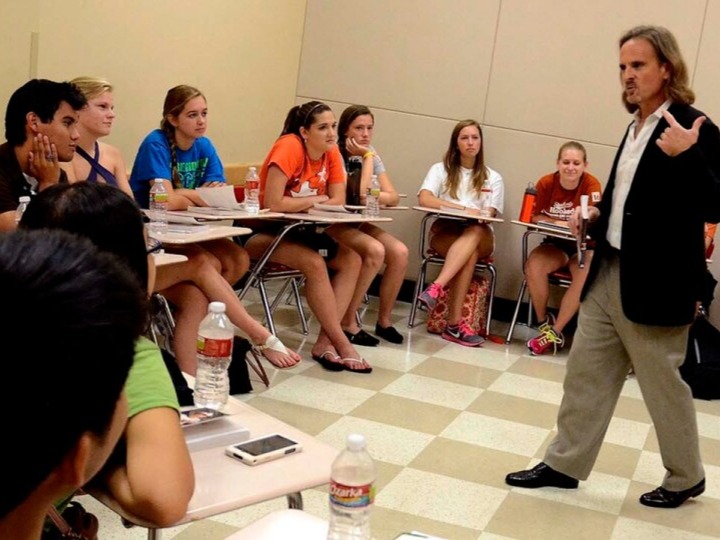
Prof. Doug Bruster teaches an LAH seminar.
About Liberal Arts Honors Upper-Division Courses
Upper-division LAH courses are small seminars, typically with fewer than 20 students, that allow our students to work closely with distinguished faculty members and to explore topics from a variety of disciplines from across the liberal arts.
These courses might be inter-disciplinary in content (for example, a mix of historical philosophical, and literary texts), in methodology (for example, a study on politics from an economic standpoint), or pedagogy (for example, a course on literary texts, taught by a historian or a lawyer or a journalist).
The rigor of an LAH course must be comparable to that of any departmental honors seminar. Students will develop advanced proficiencies in research, writing, and analysis, which will prepare them for future thesis projects or post-graduate work.
What makes an LAH course different?
The intimate size of an LAH seminar lends itself to meaningful discussions and learning over the course of a semester. LAH students represent the best of COLA and all its fields of study, and the combination of these cross-disciplinary perspectives create a rich learning experience for everyone.
If a course topic has previously been offered as a non-honors section, faculty members should develop activities that distinguish the LAH course from earlier iterations.
Examples of LAH upper-division courses
Visit our Courses page to see a full list of past, current, and upcoming Liberal Arts Honors courses. Here are some examples of our most popular LAH seminars:
- Guns in America (Prof. Michael Sierra-Arévalo, Sociology): a broad study of firearms in the US, drawing on social science, law, medicine, and public policy
- The Johnson Years (Prof. Mark Lawrence, History, and Prof. Mark Updegrove, LBJ Foundation): a close study of the LBJ legacy, with special access to primary sources and close observers
- Gender Equality in World Development (Prof. Wendy Hunter, Government): examination of the causes and consequences of gender equality and inequality in the world
- Adventures in Social Psychology (Prof. Sarah Angulo, Psychology): student-driven exploration of psychology
- Money in American Politics (Prof. Brian Roberts, Government): exploration of the nature and consequences of money in American politics