
About Us
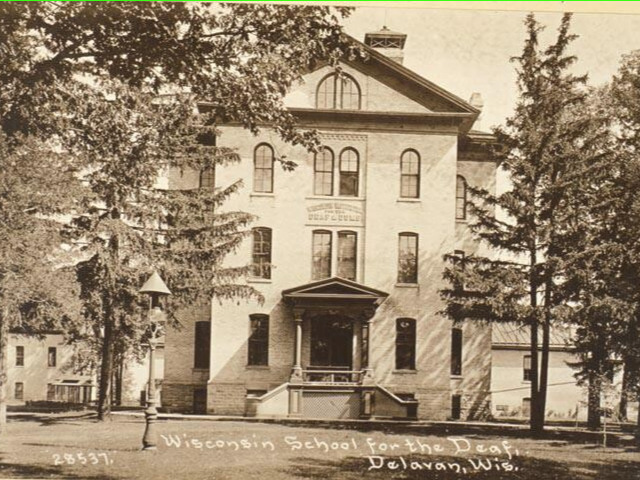
The Wisconsin School for the Deaf in Delavan, Wisconsin.
Expanding the Linguistic Frontier
All human languages evolve, whether spoken or signed. While two centuries of historical linguistics have established rich theoretical frameworks for spoken languages, the visual modality offers a vast, exciting frontier for new discovery.
The Sign Change research group explores different methods and theoretical models for understanding how to study language change in the visual modality, how sign languages change, and that change compares to spoken languages. Our work is driven by several core questions:
-
Do generalizations made about change in spoken languages extend to sign languages?
-
Do certain processes of change only pertain to the spoken modality?
-
Do certain types of change described for sign languages also appear in the histories of spoken languages?
-
What types of change uniquely characterize the visual modality?
Re-evaluating Language Families
In developing notions about how signed languages change, we seek to identify and understand the historical relationships among them. Parallel to the classification of spoken languages, sign languages also fall into families – but based on quite different evidence.
In traditional historical linguistics, classifying spoken languages into families rests largely on regular recurring sound correspondences (such as the famous Grimm’s Law) identified through the Comparative Method. This asserts that the languages all developed organically from a common ancestral language.
However, the nature of sign language communities, and the substantial role formal institutions like schools for the deaf play in language transmission, raises a critical question: do sign language families represent the same kind of historical relationships of descent from a common ancestor?
Our Approach and Team
Our group interrogates these historical notions by combining traditional frameworks, such as the Comparative Method, with modern statistical methods for inferring language relationships and modeling the processes of change and transmission over time.
The Sign Change group is led by researchers Justin Power, Danny Law, and David Quinto-Pozos, and is directed by Justin Power.