
Pandemic stressors and mental health among Hispanic college students
How COVID-19 Pandemic Stressors Affect Stress Levels and Mental Health among Hispanic College Students
Elma I. Lorenzo-Blanco, Minyu Zhang, & Seth J. Schwartz
The COVID-19 pandemic disrupted the lives of many college students, especially those in their first year of college. When campuses closed in March 2020, students could no longer participate in in-person classes and lost much of their ability to connect socially. Many faced loneliness, depression, and anxiety.
Hispanic college students experienced unique challenges, which were often linked to being first-generation college students. Limited access to study spaces, reliable internet, and quiet learning environments made the transition to online learning difficult. Many Hispanic students also faced added pressure from family responsibilities and financial instability. The pandemic likely amplified challenges like isolation, discrimination, few faculty role models, and lower academic expectations among faculty for Hispanic students.
This brief is based on a study [1] that surveyed 559 first-year Hispanic college students at a public university in Texas over three semesters in 2020 and 2021. The study had three objectives. The first was to develop a valid measure for a range of pandemic-related stressors for Hispanic college students. The second was to explore how the new measures for pandemic-related stressors were associated with general stress measures, measures assessing stress from acculturation, age, and whether someone was born in the U.S. or another country. The third objective was to examine how pandemic-related stressors affected mental health among Hispanic first-year college students over time.
Mental health includes both well-being and distress, and students can experience high distress and high well-being at the same time. By measuring depression, anxiety, hope, and self-esteem, the study offers a fuller picture of how students experienced life during and after college campus closures related to the COVID-19 pandemic.
Key Findings
-
The researchers developed valid and reliable survey questions related to stressors attributable to the pandemic.
-
Hispanic college students experienced these pandemic-related stressors, which were related to education, health, relationships, society, finances, and death and loss.
-
Most pandemic-related stressors were linked to both general stress and stress associated with acculturation.
-
Some pandemic-related stressors mattered for self-esteem, hope, anxiety, and depression.
-
Hispanic college students also reported positive changes, such as more family time and self-care, due to the pandemic.
-
Positive changes were linked to higher hope and self-esteem.
The researchers developed valid and reliable survey questions related to stressors attributable to the pandemic. The new measures reflect concerns that Hispanic college students in Texas perceived during and following the pandemic-related lockdowns. Although the COVID-19 pandemic has ended, future pandemics are likely to emerge, and future studies can use these measures.
Hispanic students experienced stressors attributable to the pandemic across six domains. These included: education, health, relationships, finances, social life, and death and loss. Domains covered struggles with online learning, worsening health, strained relationships, and financial difficulties.
Most pandemic-related stressors were linked to both greater general stress and stress associated with acculturation. All the pandemic-related stressors were linked to higher stress associated with acculturation, and all but death and loss stressors were related to general stress.
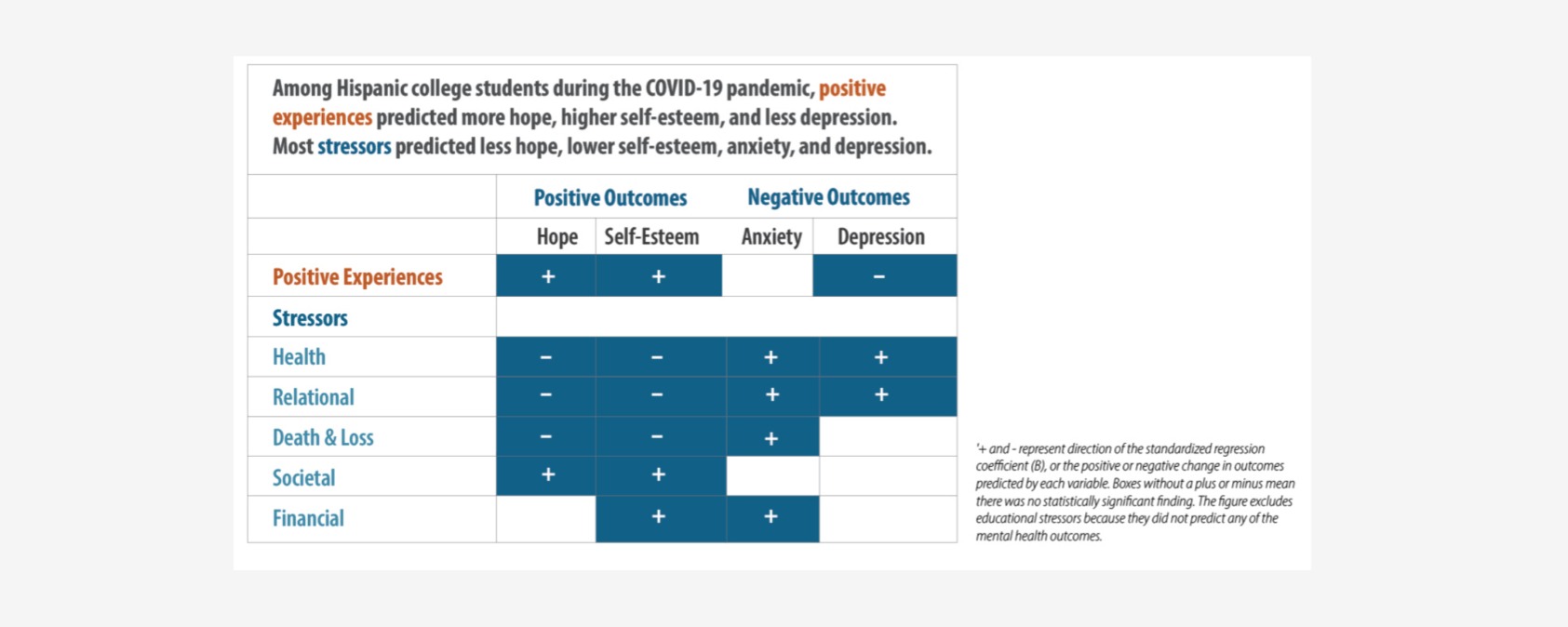
Some pandemic-related stressors mattered for self-esteem and hope.
-
Health-related stressors, death and loss stressors, and relational stressors—which centered on family conflicts and on problems with friends and family members—predicted lower hope and self-esteem over time (see figure).
-
Societal and financial stressors predicted increased hope and self-esteem. It is possible that students coped with the uncertainty of the pandemic through positive thinking about themselves and the future, contributing to higher hope and self-esteem. Results about financial stressors might reflect optimistic anticipation at the beginning of the pandemic that financial conditions would improve once the lockdowns ended and businesses reopened. Students might have externalized these financial stressors, knowing that they did nothing to cause these problems.
Some pandemic-related stressors mattered for anxiety and depression.
-
Health-related stressors and relational stressors predicted higher depression and anxiety.
-
Death and loss stressors predicted higher anxiety.
-
Educational stressors were not linked to any of the mental health outcomes.
Students reported positive changes during the pandemic. Positive changes included more time with family, new hobbies, healthier routines, less time commuting, and more time enjoying the outdoors.
Positive experiences during the pandemic among Hispanic college students predicted higher hope and self-esteem in later months.
Policy implications
Colleges and universities can use these findings to design programs that address both the negative and positive impacts of crises. Efforts could include targeted mental health support for first-generation and Hispanic students, programs to reduce isolation, and initiatives to maintain positive changes like increased family connection and personal growth. Planning for future disruptions should involve creating accessible support systems that protect students’ well-being during emergencies.
Data and Methods
Researchers surveyed 559 first-year Hispanic college students at a public university in Texas. Online surveys were conducted in Fall 2020, Spring 2021, and Fall 2021. Standardized measures assessed depression, anxiety, hope, self-esteem, perceived stress, and stress associated with acculturation. Questions also addressed positive changes such as improved relationships and personal growth. The survey included questions on collectivism (students’ orientation toward cooperative values), nativity (U.S. or foreign born), age, gender, student employment, and parents’ education. The researchers developed new measures to assess pandemic-related stress related to education, health, relationships, finances, social issues, and experiences of loss.
The study tested the reliability and validity of the measures assessing the pandemic-related stressors and how they were associated with measures assessing general stress, stress related to acculturation, age, and nativity. Regression analyses examined how stressors reported in the first survey predicted self-esteem, hope, anxiety, and depression in later surveys. The regression analyses accounted for age, gender, nativity, employment, and parents’ education.
Reference
[1] Lorenzo-Blanco, E. I., Zhang, M., & Schwartz, S. J. (2025). Mental health among Hispanic college students during the COVID-19 pandemic: Concurrent and predictive effects of negative and positive COVID-19 changes. Journal of American College Health, 73(4), 1697–1710. https://doi.org/10.1080/07448481.2024.2378300
Suggested Citation
Lorenzo-Blanco, E. I., Zhang, M., & Schwartz, S. J. (2025). How COVID-19 pandemic stressors affect stress levels and mental health among Hispanic college students. Population Research Center Research Brief 10(11). https://doi.org/10.26153/tsw/61360
About the Authors
Elma I. Lorenzo-Blanco, elma@utexas.edu, is an associate professor in the Department of Human Development and Family Sciences and a faculty scholar at the Population Research Center at The University of Texas at Austin; Minyu Zhang is a data manager at the Latino Research Institute, UT Austin; and Seth J. Schwartz is professor in the Department of Kinesiology and Health Education and a faculty affiliate at the Center for Aging and Population Studies, UT Austin.
Acknowledgements
This work was supported by grant P2CHD042849 from the Eunice Kennedy Shriver National Institute of Child Health and Human Development (NICHD) awarded to the Population Research Center at The University of Texas at Austin and grant K01AA028057-01A1 from the National Institute on Alcohol Abuse and Alcoholism. The content is solely the responsibility of the authors and does not necessarily represent the official views of the National Institutes of Health or other funders.