
Educational aspirations and COVID-19 vaccine beliefs
Educational Aspirations Help Shape Beliefs About COVID-19 Vaccines among Mexican-origin Youth
Tianlu Zhang, Wen Wen, Kiera M. Coulter, Hin Wing Tse, Su Yeong Kim
During the COVID-19 pandemic, the Hispanic population faced higher rates of infection and death than White populations. Mexican-origin young adults represent the largest group within the Hispanic community and were disproportionately affected by COVID-19.
Systemic barriers, such as lack of access to vaccination facilities and negative beliefs about COVID-19 vaccines within Hispanic communities hindered vaccine uptake. Additionally, young adults were more likely to put off getting vaccinated because they did not think the disease was very serious and also felt they were less susceptible to becoming infected. A first step to closing gaps in health disparities and promoting future vaccination efforts is to understand factors influencing COVID-19 vaccine beliefs within Hispanic communities.
Research shows that educational attainment, or the years of education that a person has completed, is linked to health literacy and vaccine beliefs. Higher educational attainment is associated with greater knowledge, fewer barriers to information, and more positive attitudes toward vaccines. The problem with focusing on educational attainment for young adults is that many youth (defined as those aged 17 to 24), have not yet completed their education. Other aspects of education, such as how many years of education a young person expects to achieve and parents' education levels, may also influence vaccine beliefs. Youth with expectations for greater educational attainment are often more future-oriented and may view vaccination as beneficial for their long-term success.
This brief is based on a recent study [1] that builds on an existing model of health literacy and examines how four educational factors—youth's educational attainment and expectations and both parents’ educational attainment—relate to COVID-19 vaccine beliefs among Mexican-origin youth. Using longitudinal survey data (2013-2023) from Mexican-origin families in central Texas, the study assesses how these factors are related to motivation to vaccinate, attitudes toward COVID-19 vaccines, access to vaccine information, and vaccine hesitancy.
Key Findings
-
Educational expectations, more than attainment, predict vaccine beliefs among Mexican-origin youth.
-
Parents’ education matters for Mexican-origin youth’s vaccine beliefs, but less so when youth expectations are considered.
-
A multidimensional view of education is essential for understanding Mexican-origin youth’s beliefs about vaccines.
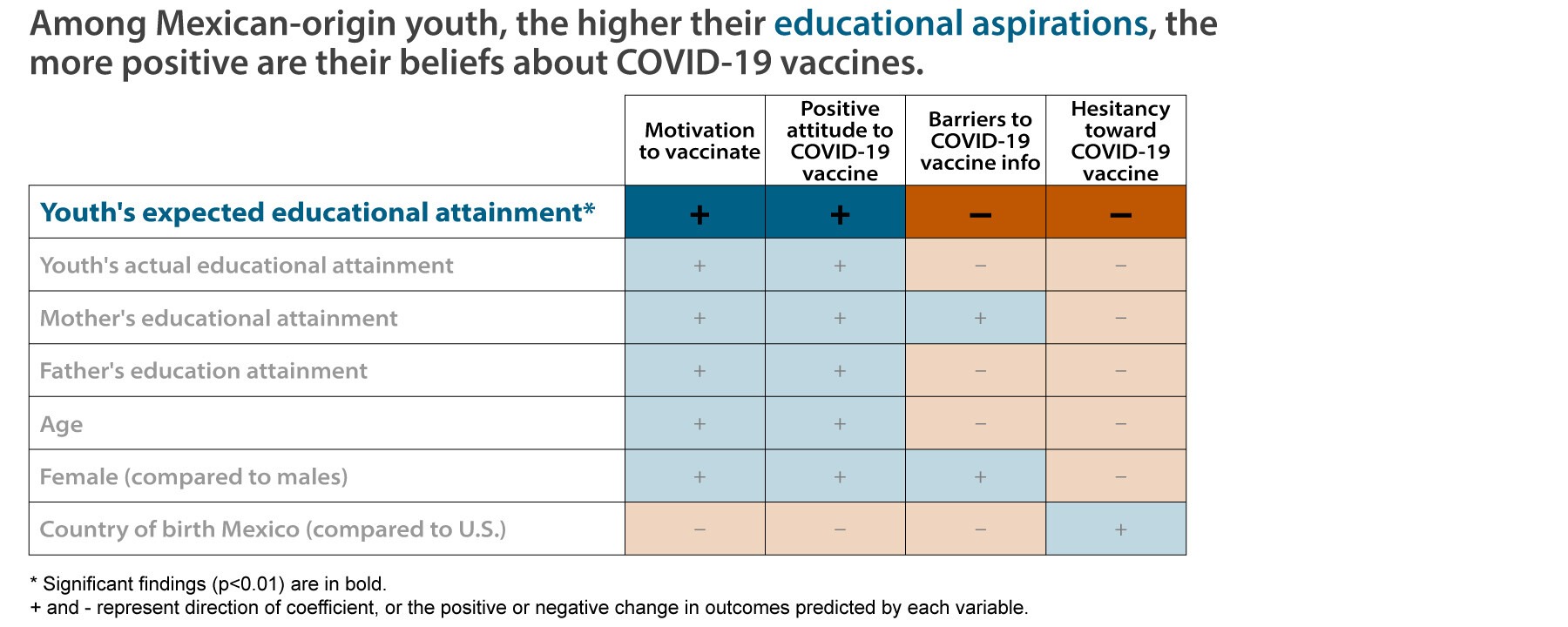
Educational expectations, more than attainment, predict beliefs about vaccines among Mexican-origin youth. Youth with higher educational expectations reported greater motivation to vaccinate, more positive attitudes toward vaccines, fewer barriers to information, and lower vaccine hesitancy—effects that held even when controlling for actual educational attainment and parents’ education (see figure).
Parents’ education matters for Mexican-origin youth’s beliefs about vaccines, but less so when youth expectations are considered. Although both mothers’ and fathers’ education levels were linked to young people’s beliefs about vaccines, these links disappeared when the statistical models also included the young people’s own expectations for how far they would go in school (see figure).
A multidimensional view of education is essential for understanding Mexican-origin youth’s beliefs about vaccines. This study highlights why it is important to consider educational attainment and also educational expectations and parental education when examining Mexican-origin youth’s beliefs about vaccines.
Policy Implications
These findings underscore the importance of fostering and nurturing educational aspirations among Mexican-origin youth, as these aspirations are strongly linked to more positive beliefs about COVID-19 and fewer barriers to information about vaccines. Policymakers and educational institutions should enhance educational outreach in schools with large populations of low-income and ethnic-minority students, highlight academic opportunities and financial aid, and illustrate the pathways to higher education.
These results also provide insights for developing strategies that promote vaccines among Hispanic youth. In communications with young patients, healthcare professionals and clinicians can connect the benefits of vaccination to a young person’s educational and career goals. Leveraging young people’s intrinsic motivation and linking behaviors that promote health—such as vaccination—to aspirations for a successful future can potentially foster favorable attitudes toward vaccines.
Data and Methods
The study draws on four waves of data from Mexican-origin families in central Texas that were collected from 2012 to 2023. Participants' average age was 13 in 2012 and 21 in 2023. The researchers recruited participants via school presentations, public records, and community outreach events. Bilingual and bicultural interviewers administered surveys in English and Spanish. The final data included 229 Mexican-origin youths, 224 of their mothers, and 100 of their fathers.
Measures included youth’s gender, country of birth, and age. Youth reported their educational expectations in Wave 4. Parents reported their educational attainment in previous waves. In Wave 4, youth responded to questions about their COVID-19 vaccine beliefs, including their motivation to be vaccinated, attitudes towards the vaccine, hesitancy toward the vaccine, and barriers to getting information about the vaccine. The authors conducted correlation and regression analyses to explore the relationship between youth and parental education variables and COVID-19 vaccine-related beliefs.
Reference
[1] Zhang, T., Wen W., Coulter, K.M., Tse, H.W., & Kim, S.Y. (2025). Familial educational factors and COVID-19 vaccine beliefs among Mexican-origin youth. Journal of Immigrant and Minority Health 27:465–471. https://doi.org/10.1007/s10903-025-01678-x
Suggested Citation
Zhang, T., Wen W., Coulter, K.M., Tse, H.W., & Kim, S.Y. (2025). Among Mexican-origin youth, educational aspirations help shape beliefs about COVID-19 vaccines. Population Research Center Research Brief 10(4). https://doi.org/10.26153/tsw/60734
About the Authors: Tianlu Zhang, tianlu.zhang@utexas.edu, and Hin Wing Tse are Ph.D. students in the Department of Human Development and Family Sciences at The University of Texas at Austin; Wen Wen is a postdoctoral researcher at the University of Chicago; Kiera M. Coulter is an NICHD postdoctoral fellow in the Population Research Center, UT Austin; and Su Yeong Kim is a professor in the Department of Human Development and Family Sciences and faculty scholar in the Population Research Center at UT Austin.
Acknowledgements
This work was supported by awards to Su Yeong Kim from: the National Science Foundation, Division of Behavioral and Cognitive Sciences, grants 1651128, 0956123; National Institute on Minority Health and Health Disparities grants 5R21MD012706-02, 3R21MD-012706-02S1; Eunice Kennedy Shriver National Institute of Child Health and Human Development (NICHD) grant 5R03HD060045-02; Russell Sage Foundation grant 2699; Spencer Foundation grant 10023427, Hogg Foundation for Mental Health JRG-102; Office of the Vice President for Research and Creative Grant and Special Research Grant from The University of Texas at Austin; and College of Natural Sciences Catalyst Grant from UT-Austin. This work was also supported by the Eunice Kennedy Shriver National Institute of Child Health and Human Development (P2C HD042849 and T32HD007081) awarded to the Population Research Center at The University of Texas at Austin. The content is solely the responsibility of the authors and does not necessarily represent the official views of the National Institutes of Health or other funders.