
A season of transition
Casey Breen joins the Department of Sociology
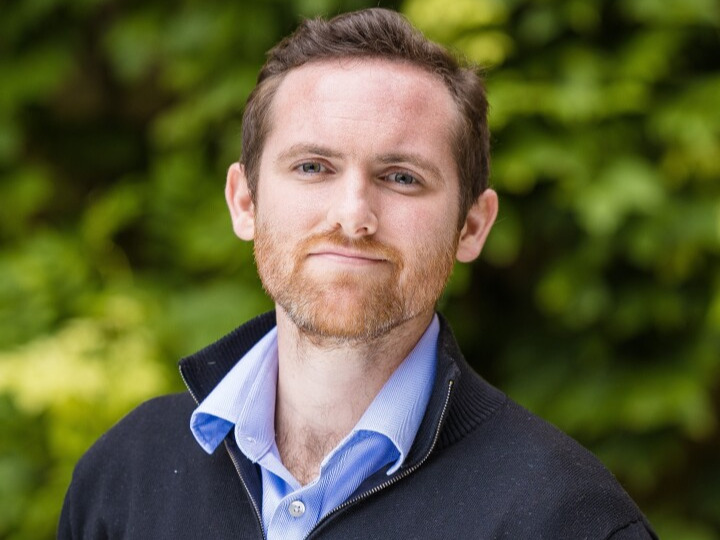
Casey Breen
Matthew Blanton
When Casey Breen joined The University of Texas at Austin as an assistant professor this fall, he quickly found himself drawn to the classroom. “The students have been incredibly engaged and inspiring,” Breen says. “I genuinely look forward to my teaching days.”
Teaching is just one of several transitions Breen is navigating this year. He arrived in Austin after a postdoctoral fellowship at the University of Oxford and completing his PhD at UC Berkeley. He is also a new father. Seemingly unfazed by this exciting season of change, Breen is energized by what lies ahead—a new role in the Department of Sociology and the Population Research Center, a research agenda poised to benefit from the ongoing explosion in administrative data, and the kind of big questions that drew him to academia in the first place.
Breen’s primary research centers on the striking health and mortality disparities in the United States. He is currently tackling one of demography’s most enduring puzzles: why, at the most advanced ages, do Black Americans paradoxically experience lower mortality than white Americans — despite facing higher mortality throughout the rest of the life course? The pattern, known as the Black-white mortality crossover, has puzzled scholars for nearly a century. “No one has a definitive answer,” Breen says.
Part of the problem has been data quality and availability. Researchers couldn’t be sure what they were measuring was real or simply errors like exaggerated ages, and they lacked the ability to track actual birth cohorts over time. That is now changing. At Berkeley, Breen worked with demographer Joshua Goldstein on the CenSoc project, which links full count Census data with Social Security administrative mortality records. At UT, Breen plans to build data and computing infrastructure to support large-scale linked datasets, including full-count census records, administrative mortality data, and crosswalks. These and other large-scale data linkages make it possible to construct longitudinal cohorts and revisit longstanding questions with new power.
Though Breen’s toolkit spans formal demographic methods, social network analysis, and other computational and machine learning methods, he sees all of it as means to an end. “I always lead with the question,” he says. The interesting social questions come first; the methods follow — sometimes requiring “developing new methods or creative applications of existing ones.”
The sense of transition extends beyond the personal. Breen also sees reason for optimism amid the rapid rise of AI in social science research. Sociology’s emphasis on theory, he argues, could become an unexpected advantage as new data and computational tools make it possible to better test longstanding theoretical questions. “I feel very uncertain about how this will all play out, but perhaps we’ll invest more in theory development as empirical analyses become increasingly automated,” he says. “That would be a best-case scenario.” He also expects sociologists to play a central role in studying AI—its societal impacts, questions of algorithmic bias, and related issues where social scientists bring perspectives that technical fields often lack. “There are lots of opportunities for sociologists to contribute.”
Between new data, new methods, and a new generation of students, Breen has no shortage of questions to lead with—and a new intellectual home from which to pursue them.
Matthew Blanton is a PhD candidate in Sociology and a predoctoral trainee at the Population Research Center at the University of Texas at Austin. His research examines forced migration, violence, and social change in Latin America, with a particular focus on Central America. His work has been published in peer-reviewed journals including International Migration Review, Society and Mental Health, and Socius. He also contributes to public scholarship, with writing featured in outlets such as The Boston Globe, The Hill, and The Conversation. Alongside his teaching and research in the Department of Sociology, he also teaches courses in data computing and biostatistics for the Health Transformation Research Institute at Dell Medical School.