
Initiatives
The LRC and its affiliates conduct research and produce resources across a wide range of topics. Here we point to some of the most salient initiatives under development.
Lexica
The LRC has several projects which study the histories of words across related languages. The Indo-European Lexicon (IELex) served as the first attempt to construct such a resource, but ongoing work is developing similar resources for a number of language families across the globe. Several more lexica are already under way: for the Mayan languages (MayaLex), the Uto-Aztecan languages (UtoAztecaLex), the Dravidian languages (DravidiLex), and the Semitic languages (SemitiLex).
- What are lexica?
Lexicon (plural: lexica) is basically a fancy word for a dictionary. But for linguists it means just a little bit more. A dictionary is just a book, a collection of words and definitions. Linguists use the word lexicon for that, but also to represent the dictionary in the head of every speaker of a language. That is, as speakers of a language, we all walk around with (roughly) a list of words and their definitions in our head. Linguists use lexicon to refer to that as well.
- Word histories — etyma and reflexes
The Spanish word padre descends from the Latin word pater. Linguists call Latin pater the etymon (plural: etyma) of Spanish padre, and Spanish padre is a reflex of Latin pater. That is, an etymon is the parent of a word, an earlier word form from which it derives. A reflex is the descendent of some word, a word into which it evolved over time. A single etymon like Latin pater may have several reflexes: Spanish padre is one, but French père is another. Thus, several words (like padre and père) may derive from a single etymon (pater).
- Accordion 3Panel 3. Add body text in this space.
- Accordion 4Panel 4. Add body text in this space.
- Accordion 5Panel 5. Add body text in this space.
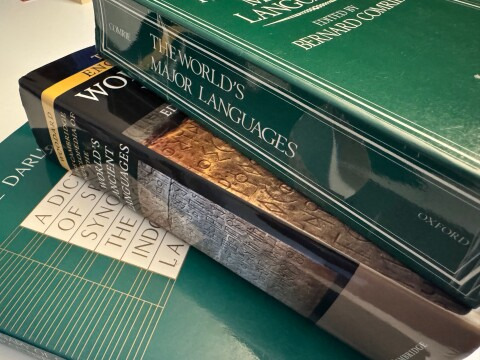
Photo Credit.
Lex Project
The Lex project provides a computational infrastructure for the collaborative creation and maintenance of online lexical resources. These document the vocabulary of particular language families, linking dictionaries of individual languages to one another through a central etymological core.
Learn More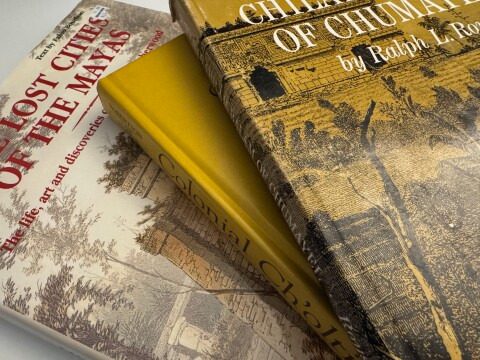
Photo Credit.
MayaLex Project
Speakers of Mayan languages form intricate networks of communities with a shared linguistic and cultural past that stretch throughout Mesoamerica. The MayaLex project seeks to encapsulate the intricate historical connections among words found in the lexica of the individual languages.
Learn More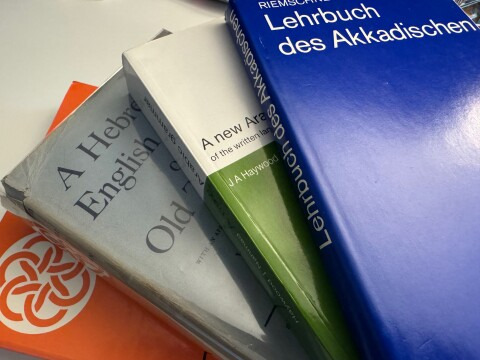
Photo Credit.
SemitiLex Project
The Semitic family includes Arabic and Hebrew, languages of the foundational documents of two of the world’s major religions. But the family includes a number of intertwined languages, many with documents dating back to ancient times. SemitiLex seeks to make the lexica of these languages more readily accessible, while also highlighting the interrelationships bound up in the word histories.Enter your paragraph text here.
Learn More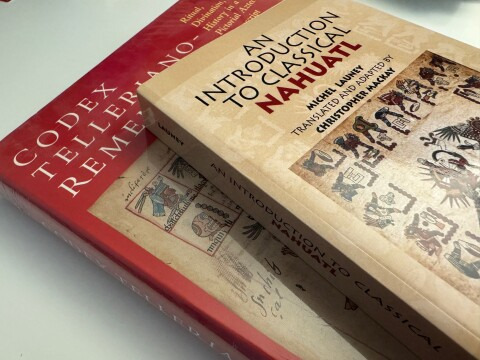
Photo Credit.
UtoAztecaLex Project
UtoAztecaLex documents the vocabulary of a family of languages that includes Nahuatl, whose early form served as the common tongue of the Aztec empire and which survives in a rich collection of documents extending back to pre-colonial times. UtoAztecaLex provides an explorative interface to the intertwined vocabularies of Nahuatl and its linguistic relatives.Enter your paragraph text here.
Learn More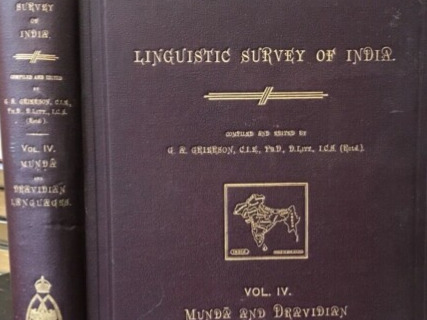
Photo Credit.
DravidiLex Project
Speakers of Dravidian languages form large segments of the population of southern India and part of Sri Lanka. Through ancient imperial expansion and centuries of close cultural contact, these languages have dramatically impacted neighboring cultures. DravidiLex highlights the wide diversity of languages within this family, showcasing the historical connections that bind the family into an intricate web.Enter your paragraph text here.
Learn More
Photo Credit.
Visiting Scholars Program
The LRC cherishes the opportunity to work with international scholars. Each year scholars the world over come to the LRC to collaborate on research. The Visiting Scholars Program (VSP) furnishes a path for pursuing research while in residence at the LRC under the mentorship of LRC affiliated faculty.
Learn More
Photo Credit.
Photo Credit.
Photo Credit.
Lessons
How do you learn an ancient language? Through meticulous study! But you need scholarly yet elucidating materials to lend a hand. For better known ancient languages like Latin or Greek, such materials may be relatively easy to find. But for lesser known ancient languages, like Gothic or Tocharian, such materials rarely appear outside the confines of prestigious university libraries.
The Early Indo-European OnLine collection contains lesson series for the earliest representatives of each of the major branches within the Indo-European family of languages. Moreover, not only do they provide overviews of the entirety of the grammar of each language, but they also help learners dive right into the earliest documents by providing scaffolding for reading and piecing together excerpts from original, unsimplified ancient texts.
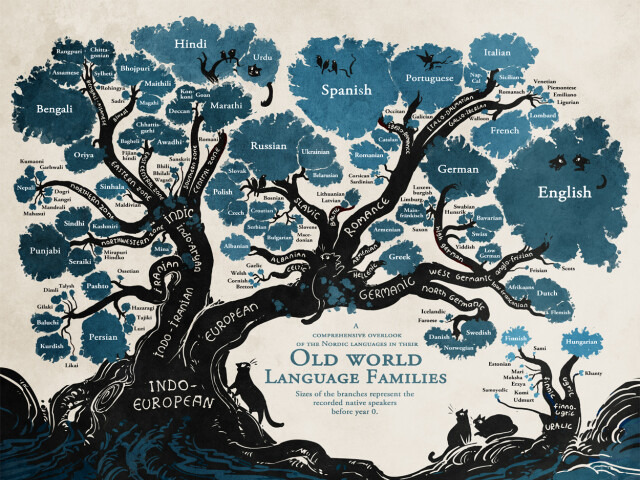
Photo Credit.
Visiting Scholars Program
The LRC cherishes the opportunity to work with international scholars. Each year scholars the world over come to the LRC to collaborate on research. The Visiting Scholars Program (VSP) furnishes a path for pursuing research while in residence at the LRC under the mentorship of LRC affiliated faculty.
Learn More
Photo Credit.