
About
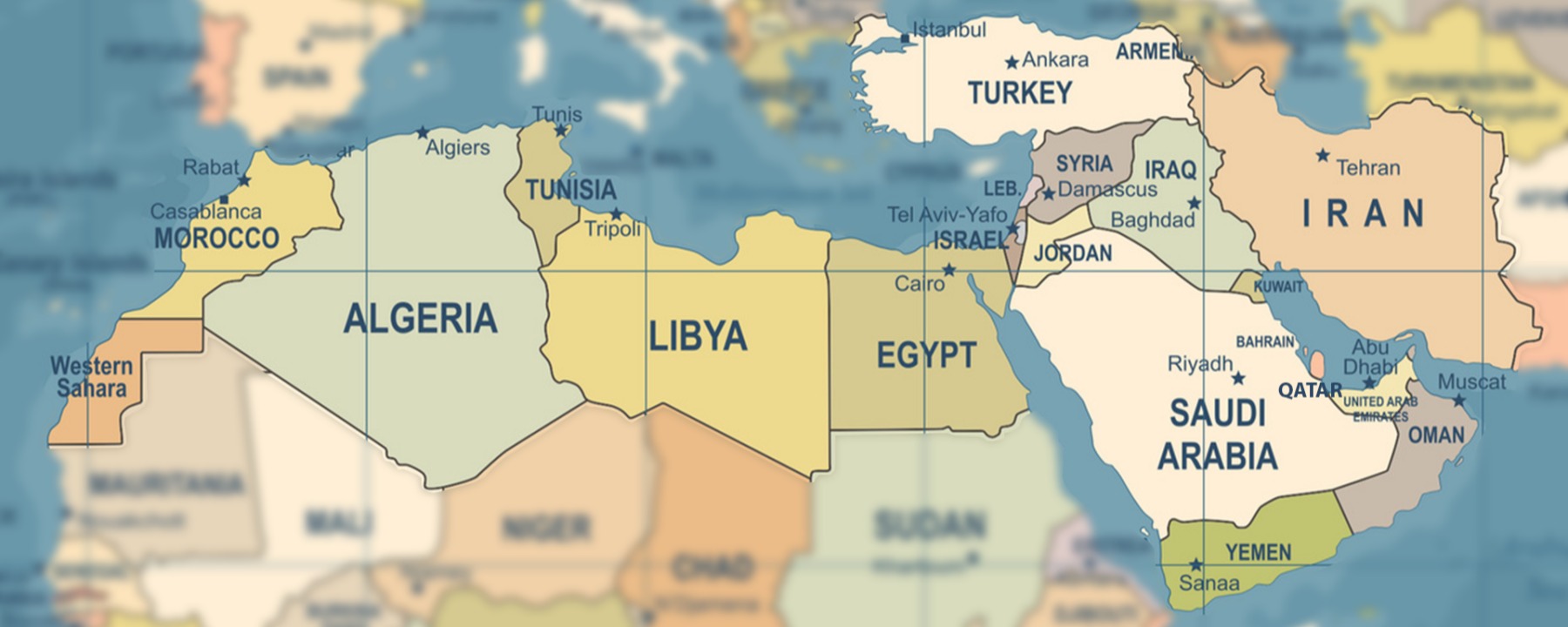
What is the Middle East?
The Middle East is where ancient texts and traditions meet contemporary social and political realities. Our focus extends from the countries of North Africa in the west to Iran in the east, from Turkey in the north to Yemen in the south – and everything in between. The ancient Near East gave us the Bible and the Qur’an, and is the birthplace of Judaism, Christianity, and Islam. The Fertile Crescent, the foremost cradle of civilization, gave humanity the very alphabet that we use every day. In fact, some of our most common words originate in the ancient Near East: mother, father, brother, and daughter (related to Persian); camel, sugar, coffee, and cotton (Arabic); jubilee, behemoth, and cherub (Hebrew); and horde, yogurt, and ottoman (Turkish). In fact, the word alphabet itself comes from Semitic languages.
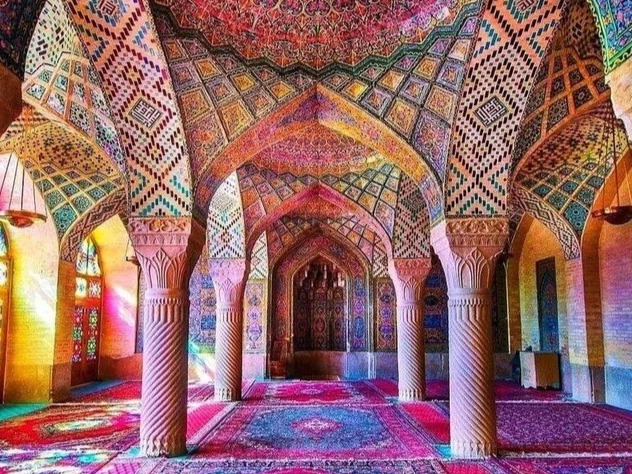
Nasir al-Mulk Mosque, Shiraz, Iran
Have you worn socks or a sweater lately? The world’s oldest examples of knitting come from the Near East. Modern algebra, from the Arabic al-jabr, was also invented in the Near East. Theories of optics, vaccines, anesthesia, and disease transmission were all highly developed in that region. And if you’ve ever read (or heard of) the ancient Greek scholars Plato, Aristotle, Galen, Euclid, Plotinus, or Porphyry, it is largely because medieval Christians and Muslims translated their works from ancient Greek into Arabic, preserving their ideas until they were translated back into Latin in the 12th century and spurring the Renaissance.
In the modern era, the Middle Eastern countries hold the earth’s largest oil and gas reserves. Petroleum has powered the modernization of the entire world, providing us everything from the gasoline in our cars to the plastic components of our cell phones to the synthetic fabrics in our clothing. The Middle East has also been a focal point of global political, military, and economic interest, giving rise to long-standing conflicts between Israel and the Palestinians, Iran and Iraq, Turkey and the Kurds, and others. All the while, the Middle East has given the world beautiful examples of music, art, and literature; towering monuments and soaring architecture; and inspiring works of philosophy, spirituality, and ethics.
What we do in CDMES
The Center for Middle Eastern Studies and the Department of Middle Eastern Studies (CDMES) are devoted to studying this pivotal region of the world. We teach ancient languages like Aramaic, Akkadian, and Biblical Hebrew, and modern languages like Arabic, Persian, Turkish, and modern Hebrew. These languages are critical to the study of the world’s historical and cultural traditions, as well as to U.S. national foreign policy and security interests. Arabic and Persian are deemed critical languages according to the State Department. Beyond the languages themselves, we teach courses in pre-modern and modern Middle Eastern topics such as history and society, literature and culture, religion and ideas, politics and law. Specifically, the teaching of foreign languages and literatures is critical to a strong liberal arts education and the formation of a well-informed citizenry.
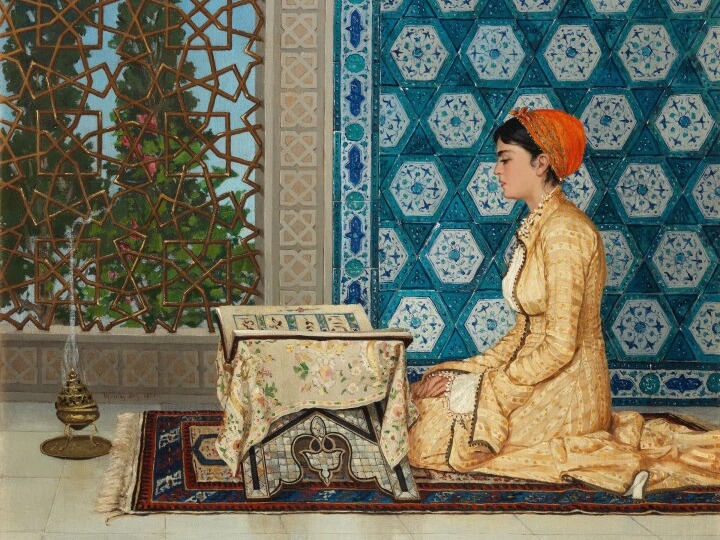
Young Woman Reading by Osman Hamdi Bey (1880)
Our faculty also publish some of the most important scholarship in their fields of study. Within the last ten years, our faculty have published books on topics ranging from biblical interpretation and Semitic linguistics to Islamic law and politics to medieval poetry and Gothic literature. Recent books by Dr. Levi Thompson (2022) and Dr. Emily Drumsta (2024) were awarded the Aldo and Jeanne Scaglione Prize for Middle Eastern Studies from the Modern Language Association. Dr. Mikiya Koyagi’s 2021 book won The Saidi-Sirjani Book Award from the Association for Iranian Studies.
CDMES is a thriving center of intellectual and cultural exchange. We host a multitude of events throughout the year that are open not only to the UT community, but to the public. So when you’re in the Austin area, feel free to attend one of our events. And if you like the work we do, please consider donating to UT Middle Eastern Studies! Your support will help our students, our publications, our community outreach, and our libraries.
Come study at CDMES!
Programs of Study
CDMES offers three programs of study: the BA in Middle Eastern Studies, the MA in Middle Eastern Studies, and the PhD in Middle Eastern Languages and Cultures. Our BA degree (36 hours) provides a broad foundation in language, history, societies, and cultures of the region, culminating in a capstone research project.
Not ready to major in MES? CDMES offers six minors that can support other degrees. And students across UT benefit from our department’s courses, regardless of major or minor. Our courses serve UT’s popular International Relations and Global Studies (IRG) major, for instance, where the Middle East is one area track. In recognition of the “great books” tradition, we teach several courses on biblical and Islamic literature that are cross-listed with the Jefferson Center’s Core Texts and Ideas (CTI) program.
Our two-year MA degree (30-33 hours) offers a similarly well-rounded graduate program culminating in a research thesis or professional report. Students also have the opportunity to pursue a dual-language MA, in which they study two Middle Eastern languages, or even a dual MA, in which they combine an MA in Middle Eastern Studies with one of seven partner programs (Public Affairs, Journalism & Media, Global Policy, Information Studies, Law, Business Administration, or Media Studies). And, for graduate students in other programs, we offer a portfolio. Our graduates are trained to contribute to a wide range of fields in the public and private sectors, or to pursue academic careers. Many of our students have gone into law, business, media, non-profit work, teaching, and the arts. Those of our students who come from the military or government return to their professions better able to serve our nation in a complex region of the world, whether through the armed forces, diplomacy, or policy. Those of our students who pursue academia gain entry into the most prestigious doctoral programs.
Our PhD program draws the brightest students from around the U.S. and the world, training them to be the next generation of scholars and professors in Middle Eastern literature and culture, history, the Bible and ancient Near East, Islamic Studies, and linguistics. In addition to completing rigorous coursework and dissertation research, our department offers individual mentorship and graduate-level workshops that are attended by graduate students across the university. Our doctoral students have gone on to acquire positions at University of Colorado Boulder, Brigham Young University, the University of Cambridge, the University of Chicago, Duke University, Mercer University, the University of Pennsylvania, Pennsylvania State University, Princeton University, Seton Hall University, and St. Edwards University, among others.
Review the Career Outcomes of our former graduate students on this page.